
Recovery Guide · RE:UP Altrincham
Contrast Therapy for Beginners
Contrast therapy means alternating hot and cold exposure, and the cold is the part that takes practice. That is why the right place for a beginner to start is a guided ice bath, not a full circuit on day one. This is what your first session actually feels like, minute by minute, and how to do it well.
Sessions run at contrast therapy Altrincham at RE:UP, 20 Huxley Street, Broadheath.
Published ·Last reviewed
Most people who are nervous about a first ice bath are nervous about the wrong thing. They picture the cold as something they have to endure for a long time. In practice the difficult part lasts about thirty seconds, and the technique for getting through it is simple enough to explain in a sentence.
If you want the science of why alternating temperatures works, that is covered in our what is contrast therapy guide. This page is the practical version: what happens, what to bring, and what beginners get wrong.
Guided first sessions in Altrincham, seven days a week from 8am.
Book a session — £20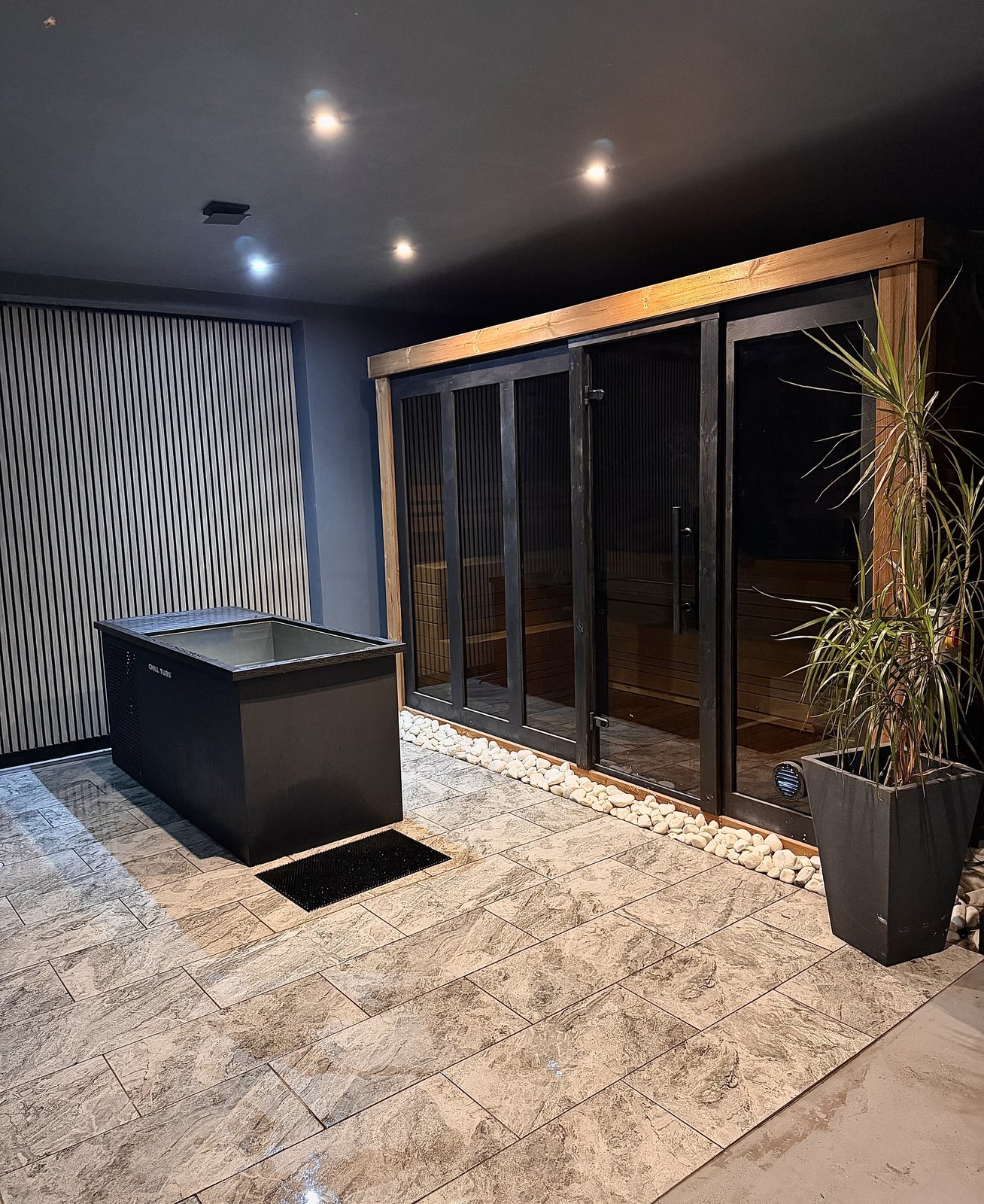
YOUR FIRST ROUNDS
Most first-timers complete three rounds in a 90-minute session. Staff are on the floor if it is your first time in cold water.
YOUR FIRST SESSION
Minute by minute
Before you get in
Three or four slow, deep breaths. Not hyperventilation, not psyching yourself up. Staff will talk you through the entry and agree a target time with you before you go anywhere near the water.
The first 30 seconds
The hardest part, and the shortest. Your breathing quickens and everything tells you to get out. Step in steadily rather than jumping. Long exhales. It peaks early and then eases.
30 to 90 seconds
Breathing settles. The cold turns from a shock into a sharp, tingling steadiness. For a first session this is where you finish, feeling like you could have stayed longer.
Getting out
Dry off and get the layers on. Move around gently rather than sitting still. Resist the scalding shower. The gradual rewarm is part of the effect, and the lifted, alert feeling arrives during it.
First time in cold water? Staff are on the floor through every session. 90 minutes, £20.
Book a session — £20Related guides
- What Is Contrast Therapy?
- Ice Bath Benefits: Do Cold Plunges Really Work?
- Sauna for Heat Tolerance
- Sauna and Ice Bath in Altrincham: Your First Session
Recovery sessions at RE:UP are bookable now — an 8-person Finnish sauna at 90–110°C and two cold plunge baths held at a consistent 4–7°C, in a single 90-minute visit. See contrast therapy in Altrincham from £20
QUESTIONS
First-timer questions, answered
Expect the first 30 seconds to be the hardest part, and expect it to get noticeably easier after that. Stepping into water at 4–7°C sets off the cold shock response. Your breathing quickens, your heart rate jumps, and every instinct tells you to get out. That is normal, it peaks early, and it usually passes within half a minute. After that most first-timers are surprised how manageable it feels. You notice a sharp tingling across the skin, then a strange steadiness as the breathing settles. Getting out, the payoff arrives quickly: warm, alert and lifted, and it lasts well beyond the session.
Sixty to ninety seconds is plenty for your first few dips. There is no benefit in forcing a long first session. The response you are after happens fast, and getting out feeling like you could have done more is the right way to finish. Over the next handful of sessions, add around 30 seconds at a time, working towards the two to four minutes that regular users settle into. Progress is not measured in duration anyway. It is how quickly you can bring your breathing under control after you get in.
Slowly, with a longer exhale than inhale. That is the whole technique. Before you get in, take three or four deep, unhurried breaths to settle. As you enter, your body will try to force short gasping breaths. Your job is to override that with a slow breath in through the nose for about three seconds, then a long controlled exhale for about six. The extended exhale is what calms the nervous system, and within a few cycles the panic response loses its grip. Do not attempt breath-holds or aggressive breathwork routines you have seen online. In cold water, simple and steady wins.
Three things: swimwear, your own towel, and warm layers for afterwards. Swimwear is whatever you would wear to a pool, nothing technical needed. Towels are not provided, so bring one. The warm layers matter more than people expect. A hoodie, joggers and thick socks make the twenty minutes after your dip far more comfortable, because your body carries on cooling slightly even once you are out and dried off. Sliders or flip-flops are a sensible extra. That is the whole kit list.
Start with short, guided, temperature-controlled sessions and increase one variable at a time. A sensible first month is one or two sessions a week, 60 to 90 seconds each to begin, adding time gradually before you change anything else. A purpose-built cold plunge held at a consistent 4–7°C is a better place to learn than a DIY bin of ice or open water, because the temperature never drifts and someone is watching your form and timing. Consistency beats intensity. Two short sessions a week for a month will adapt you far better than one heroic ten-minute effort you never repeat.
The common ones are all avoidable. Going too long too soon, treating the first session as a test of toughness rather than an introduction. Hyperventilating before entry, which makes the cold shock worse rather than better. Jumping in rather than stepping in steadily, which spikes the gasp reflex. Rushing into a scalding shower afterwards instead of letting the body rewarm naturally with layers and movement, when the gradual rewarm is part of the benefit. And doing a first session completely alone, which removes the one safety net every experienced cold-water user still keeps. A guided session quietly removes all five at once.
Anyone with a cardiovascular condition, uncontrolled high blood pressure, Raynaud's, epilepsy, or who is pregnant should speak to their GP before trying cold water immersion. Cold shock places a real and sudden demand on the heart and circulation. For healthy adults in a controlled setting that stress is short-lived and safe, but for these groups it needs a professional's sign-off first. If you are unsure whether this applies to you, ask before you book. It is a two-minute conversation.
Once the cold feels routine, meaning you can enter calmly and sit comfortably for two to three minutes, you are ready for full contrast work: heat, then cold, alternated over a circuit. That is the version of contrast therapy most people picture, and it is what a 90-minute session at RE:UP is built around: an 8-person Finnish sauna at 90–110°C and two cold plunge baths at 4–7°C in the same visit. Beginners who have already built their cold tolerance step into the full circuit with the hard part done. If the cold is still new to you, start with the plunge on its own and add the heat once it stops feeling like a fight.
YOUR FIRST SESSION
A first contrast session, guided
Nobody is thrown in at the deep end. Staff talk you through the rounds, how long to stay in and when to get out — most first-timers do three rounds in 90 minutes.
One session is £20. If you are coming more than once a month, a membership costs less per visit:
Essential
£50 /month
Four recovery sessions a month
£12.50 a visit
Unlimited
£65 /month
Unlimited sessions, up to two a day
About £7.50 a visit at twice a week
Unlimited Plus
£100 /month
Unlimited sessions plus a sports massage each month
Includes a £30 massage every month
20 Huxley Street, Broadheath, Altrincham, WA14 5EL · Open 7 days, 8am–9pm