
Recovery Guide · RE:UP Altrincham
Ice Bath Benefits
What cold water immersion does to the body. The physiology, the evidence, and what a guided ice bath does and does not achieve.
Published ·Last reviewed
DEFINITION
Cold water immersion — commonly called an ice bath or cold plunge — involves submerging the body in cold water, typically below 15°C, for a defined period. The primary physiological effects are vasoconstriction of peripheral blood vessels, a hormonal response centred on norepinephrine, and a reduction in tissue temperature and metabolic rate in the immersed areas. These effects are the basis for the recovery, mood, and anti-inflammatory applications of ice baths.
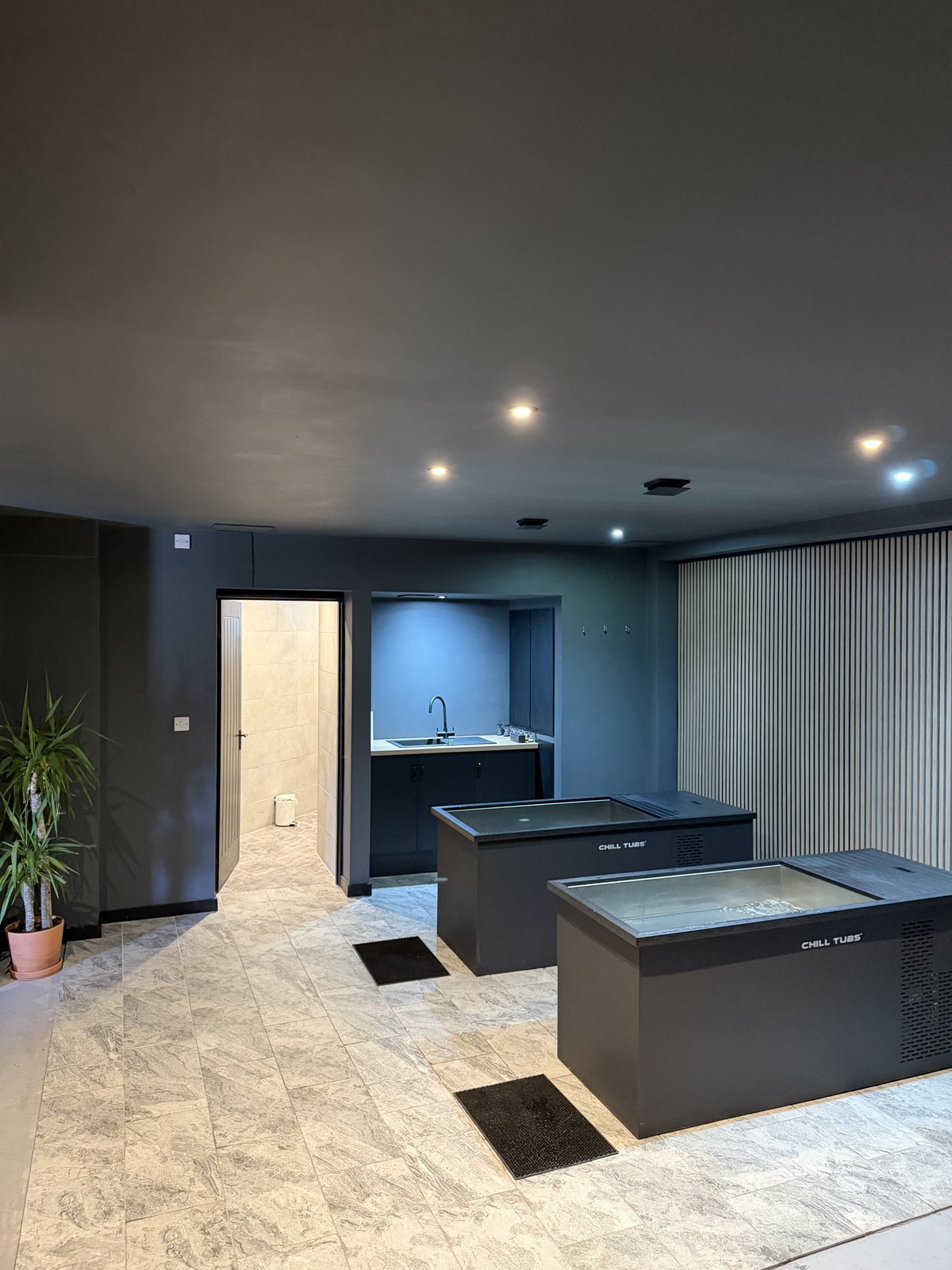
THE ICE BATH ROOM
Two Chill Tubs cold plunge baths held at 4–7°C — the temperature band used throughout this guide — with a shower alongside for after.
THE PHYSIOLOGY
What happens to the body during cold water immersion
Vasoconstriction
Cold triggers immediate narrowing of peripheral blood vessels. Blood is redirected from the skin and extremities toward the core. This reduces the delivery of metabolic waste products (lactate, hydrogen ions) to peripheral tissues and limits the inflammatory cascade in recently loaded muscles.
Norepinephrine surge
Immersion in water below 14°C produces a norepinephrine release of 200–300% above baseline. Norepinephrine is the neurochemical associated with alertness, attention, and mood. This spike is one of the most consistent and reproducible effects of cold exposure and explains the immediate mental clarity most people report on exiting the bath.
Reduction in tissue temperature
Muscle tissue temperature drops measurably within 2–3 minutes of cold immersion. Lower tissue temperature slows nerve conduction velocity and reduces the activity of inflammatory enzymes — two mechanisms thought to underlie the reduction in delayed onset muscle soreness (DOMS) after exercise.
Vasodilation on exit
When you get out, blood vessels reopen rapidly. Blood rushes back to the periphery, carrying oxygen and nutrients. This rebound circulation — repeated across multiple rounds in contrast therapy — is sometimes described as a "vascular pump" and is one of the reasons alternating heat and cold produces a stronger recovery effect than cold alone.
THE EVIDENCE
Ice bath and cold plunge benefits: what the research supports
Reduced muscle soreness (DOMS)
Strong evidenceConsistent across multiple systematic reviews and meta-analyses. Cold water immersion reduces perceived soreness in the 24–72 hours post-exercise, particularly after high-volume or eccentric loading. The effect is stronger for endurance athletes and team sport players than for strength athletes.
Faster subjective recovery
Strong evidenceAthletes report feeling more recovered and ready to train sooner after cold water immersion compared to passive rest. This subjective effect is well documented and practically relevant even when objective performance markers are equivocal.
Norepinephrine release and mood
Strong evidenceCold water immersion at temperatures below 14°C reliably produces a 200–300% increase in circulating norepinephrine. This is associated with immediate improvements in alertness, attention, and mood. The effect is consistent and reproducible across studies.
Reduced inflammation markers
Moderate evidenceStudies show reductions in some inflammatory cytokines (IL-6, TNF-α) and creatine kinase levels after cold immersion, suggesting reduced exercise-induced muscle damage. The magnitude of effect varies between studies and protocols.
Improved sleep quality
Moderate evidenceThe parasympathetic rebound after cold exposure — as core temperature normalises — is associated with improved sleep onset and quality in self-report studies. Mechanistically plausible and consistent with anecdotal reports, but larger controlled sleep studies are limited.
Reduced muscle hypertrophy (strength athletes)
Moderate evidence — adverse effectImmediate post-session cold immersion may attenuate some anabolic signalling pathways (mTOR, satellite cell activity) in the hours following resistance training. This effect is most relevant for athletes doing strength blocks where muscle growth is the primary goal. For recreational gym users or those prioritising recovery over hypertrophy, this trade-off is generally acceptable.
RE:UP Altrincham holds two cold plunge baths at 4–7°C, with a sauna beside them.
Book a session — £20INFLAMMATION
Can ice baths help reduce inflammation?
Yes, for acute inflammation. Cold water causes vasoconstriction, the narrowing of blood vessels near the skin, which cuts blood flow and swelling to the area straight after hard training or a minor strain. That is a genuine anti-inflammatory effect, and it is one of the more consistent findings in the research.
The nuance is that inflammation is not purely something to switch off. Some of it drives the repair process itself, prompting muscle tissue to rebuild and adapt to the training load. Icing straight after every strength session, particularly one aimed at building muscle, can blunt some of that signal over time. For endurance training, and for managing inflammation in joints and tendons, the anti-inflammatory effect works clearly in your favour with no real timing trade-off.
This is the cold-only picture. Combining an ice bath with heat changes the effect further. The contrast therapy guide covers that in full.
PROTOCOL
How to use cold water immersion effectively
Temperature
Effective cold water immersion for recovery and norepinephrine response requires water below 15°C. RE:UP's cold plunge baths are maintained at 4–7°C using a chiller system — producing a stronger physiological response than warmer baths, which means effective immersion time is shorter.
Duration
At 4–7°C, meaningful vasoconstriction and norepinephrine release occur within 60–90 seconds. A 2–4 minute immersion produces the full effect. There is no strong evidence for benefit beyond 5 minutes at these temperatures, and longer immersion makes it harder for the body to rewarm efficiently afterwards. Beginners should start with 60 seconds and build tolerance gradually.
Timing
For post-exercise recovery, use within 1–2 hours of training. For strength athletes concerned about hypertrophy, waiting 4+ hours or using cold on non-training days reduces the potential interference effect while preserving most recovery benefits.
Frequency
For general recovery and stress management, 2–4 times per week is practical and produces a reliable effect. Daily use is not harmful in healthy adults, but the acute "shock" response and norepinephrine spike become milder as the body adapts. Weekly use still provides meaningful benefit.
COLD ONLY VS CONTRAST
Ice bath alone vs contrast therapy (ice bath + sauna)
Cold water immersion produces real benefits on its own. Combining it with heat in a contrast therapy protocol adds the vascular pump effect — repeated vasoconstriction and vasodilation driven by alternating between hot and cold. Most research comparing the two finds contrast therapy superior for perceived recovery and DOMS reduction.
ICE BATH ONLY
- Vasoconstriction and tissue cooling
- Norepinephrine release
- Reduced DOMS
- Effective for post-exercise recovery
ICE BATH + SAUNA
- All cold-only effects plus vascular pumping
- Accelerated clearance of metabolic waste
- Stronger perceived recovery effect
- Additional parasympathetic shift from heat phase
At RE:UP Altrincham, both options are available in a single 90-minute session, cold plunge only, sauna only, or full contrast therapy. You choose how to use your time. Read the full contrast therapy guide →
Two cold plunge baths held at 4–7°C, with a sauna next to them for contrast rounds. 90 minutes, £20.
Book a session — £20CHOOSING A FACILITY
What to look for in a cold water therapy facility
Not every cold water therapy set-up does the same job. A few things separate a well-run facility from a barrel of cold water and a stopwatch.
Temperature consistency
If the water creeps warmer as the day goes on, you get less benefit without realising it. Look for a chiller system that holds a set temperature, rather than ice topped up by hand between sessions.
A guided ice bath for first-timers
Someone should walk you through your first cold plunge: how long to stay in, how to breathe through the initial shock, and when you have had enough. More time in the water is not automatically better.
Screening before you get in
A proper facility asks about health conditions before your first session, not after. Cardiovascular issues, blood pressure, and pregnancy all change whether cold water therapy is appropriate for you.
WHO BENEFITS
Who uses cold water immersion — and why
Athletes in heavy training
Runners, cyclists, footballers, and rugby players use cold plunge to reduce DOMS between sessions and maintain training frequency. 90-minute sessions after a hard day allow for a faster return to quality training the next day.
Gym members and weight trainers
Post-session cold exposure helps clear lactate and reduce perceived soreness. For those prioritising muscle growth, timing matters — leaving a gap of 4+ hours between training and cold immersion reduces interference with hypertrophy signalling.
Professionals and high-output individuals
The norepinephrine spike and subsequent parasympathetic rebound are relevant beyond sport. Many regular users report improved focus, lower baseline stress, and better sleep — effects consistent with the documented neurochemical response.
People returning from injury
Cold therapy can help manage inflammation and reduce pain sensitivity in soft tissue injuries. Post-surgical recovery protocols often include cold exposure. Combined with our sports rehabilitation service, structured cold therapy can be part of a return-to-sport plan.
SAFETY
When not to use an ice bath
Cold water immersion is not appropriate for everyone. In the first 30 to 60 seconds after you get in, your heart rate and blood pressure both climb sharply as your body reacts to the sudden change in temperature. That reaction is normal, but it is why we recommend having someone experienced with you for a first attempt, rather than heading straight into open water on your own. Do not use an ice bath if you have any of the following conditions. Consult your GP first:
- Cardiovascular disease or recent cardiac event
- Uncontrolled high blood pressure
- Raynaud's disease or peripheral vascular disease
- Epilepsy
- Pregnancy
- Active open wounds or skin infections
- Medication affecting temperature regulation or blood pressure
RE:UP staff screen all first-time visitors for contraindications before their session. Cold water immersion and contrast therapy are recovery modalities, not medical treatments.
TRY IT AT RE:UP ALTRINCHAM
Two cold plunge ice baths, kept at 4-7°C
Cold water immersion done properly: two plunge baths held at 4-7°C, paired with an 8-person Finnish sauna so you can run real contrast rounds rather than one cold dip.
One session is £20. If you are coming more than once a month, a membership costs less per visit:
Essential
£50 /month
Four recovery sessions a month
£12.50 a visit
Unlimited
£65 /month
Unlimited sessions, up to two a day
About £7.50 a visit at twice a week
Unlimited Plus
£100 /month
Unlimited sessions plus a sports massage each month
Includes a £30 massage every month
20 Huxley Street, Broadheath, Altrincham, WA14 5EL · Open 7 days, 7am–9pm
Related guides
- Contrast Therapy Guide: Ice Bath + Sauna Protocol
- Sauna Benefits for Athletes
- Marathon Recovery: Race Day and Beyond
- Sauna and Ice Bath in Manchester
RE:UP Altrincham offers purpose-built cold plunge ice baths maintained at 4–7°C. Book a recovery session from £20 →
QUESTIONS
Ice bath questions — answered
When you immerse in cold water, blood vessels in the skin and extremities constrict immediately (vasoconstriction). Blood is redirected to the core to protect vital organs. The cold triggers a norepinephrine release — typically 200–300% above baseline at temperatures below 14°C. On exit, peripheral blood vessels reopen and blood rushes back outward. This rapid change in blood flow and the accompanying hormonal response are the basis of most ice bath benefits.
Yes — this is the most consistent finding in the research. Cold water immersion reduces perceived muscle soreness (DOMS) in the 24–72 hours following exercise, particularly after high-volume or eccentric loading. The effect is stronger for endurance athletes and team sport players than for strength and power athletes, where regular post-session cold exposure may blunt some hypertrophy signalling.
For general recovery and DOMS reduction, 2–4 minutes at temperatures between 10–15°C is effective. At colder temperatures (4–7°C, as RE:UP's baths are set), meaningful vasoconstriction and norepinephrine release occur within 60–90 seconds. There is no strong evidence that staying longer than 5 minutes produces additional benefit at these temperatures. Beginners should start with 60 seconds and build.
Research protocols typically use 10–15°C for recovery purposes. Cold exposure for norepinephrine response occurs below 14°C, with the effect strengthening as temperature drops. Purpose-built cold plunge facilities like RE:UP maintain baths at 4–7°C using chiller systems — colder than most research protocols, but producing a stronger and faster physiological response. This means effective immersion times are shorter than at warmer temperatures.
Cold exposure produces a reliable and significant norepinephrine spike — the same neurochemical involved in alertness, focus, and mood regulation. This effect has been documented consistently in research. After the session, many people report a pronounced calm state and improved sleep that night, likely related to the parasympathetic rebound as core temperature normalises. The evidence for long-term mental health effects is less robust, but the short-term mood effect is well established.
For recovery purposes — reducing soreness, clearing metabolic waste — use it within 1–2 hours after training. Using cold immersion immediately before training may blunt neural drive and reduce power output. Some research suggests a gap of 4+ hours between cold exposure and strength training preserves hypertrophy signalling better than immediate post-session use.
Cold water immersion is not suitable for people with cardiovascular conditions, uncontrolled hypertension, Raynaud's disease, peripheral vascular disease, epilepsy, or those who are pregnant. It is also inadvisable if you are on medication that affects temperature regulation or blood pressure. If you have any of these conditions, consult your GP before using cold plunge facilities.
Cold showers produce a much weaker physiological response than full-body immersion. The key mechanisms — vasoconstriction of large muscle groups, the full norepinephrine spike, and the thermal load on the body — all require immersion of the limbs and torso. A cold shower is better than nothing but is not a substitute for cold plunge immersion in terms of physiological effect.
There is no evidence that daily cold water immersion is harmful in healthy adults. However, if your primary goal is building muscle or improving strength, using cold immersion immediately after every session may reduce the training adaptation over time. For general recovery, stress management, and sleep — daily use is reasonable. Most regular users find 2–4 times per week produces the best combination of results and practical sustainability.
RE:UP Altrincham at 20 Huxley Street, Broadheath has two purpose-built cold plunge baths maintained at 4–7°C using chiller systems. Included in a 90-minute recovery session from £20. Open seven days a week, 7am to 9pm. No membership required to book as a guest.
Yes. Cold water triggers vasoconstriction, narrowing the blood vessels near the skin, which cuts blood flow and swelling to the area straight after hard training or a minor strain. That narrowing response is what makes it effective against acute inflammation. The caveat is that inflammation also drives muscle repair, so icing straight after every strength session can blunt some of that adaptation over time. For endurance training and joint or tendon load, the anti-inflammatory effect is a clear net positive.
No. Getting into cold water sets off a cold shock response straight away, and your heart rate and blood pressure both rise within seconds of entry. That is a normal part of the physiology, but it means people with cardiovascular conditions, uncontrolled high blood pressure, Raynaud's disease, or those who are pregnant should speak to a GP first (see the full contraindication list below). For everyone else, a supervised, temperature-controlled first session is the safer way to find out how your body responds, rather than going in alone.