
Recovery Guide · RE:UP Altrincham
What is Contrast Therapy?
The deliberate alternation between heat and cold — typically sauna followed by cold water immersion, repeated in rounds. This guide explains the physiology, the evidence, and how to do it properly.
Published ·Last reviewed
THE DEFINITION
Contrast therapy is the deliberate alternation between heat and cold exposure — typically a sauna followed by cold water immersion, repeated in rounds. The repeated temperature shift drives cycles of vasoconstriction (blood vessels narrowing in the cold) and vasodilation (blood vessels widening in the heat). This vascular pumping effect is used to accelerate physical recovery after training or competition, and is the core protocol at RE:UP Altrincham.
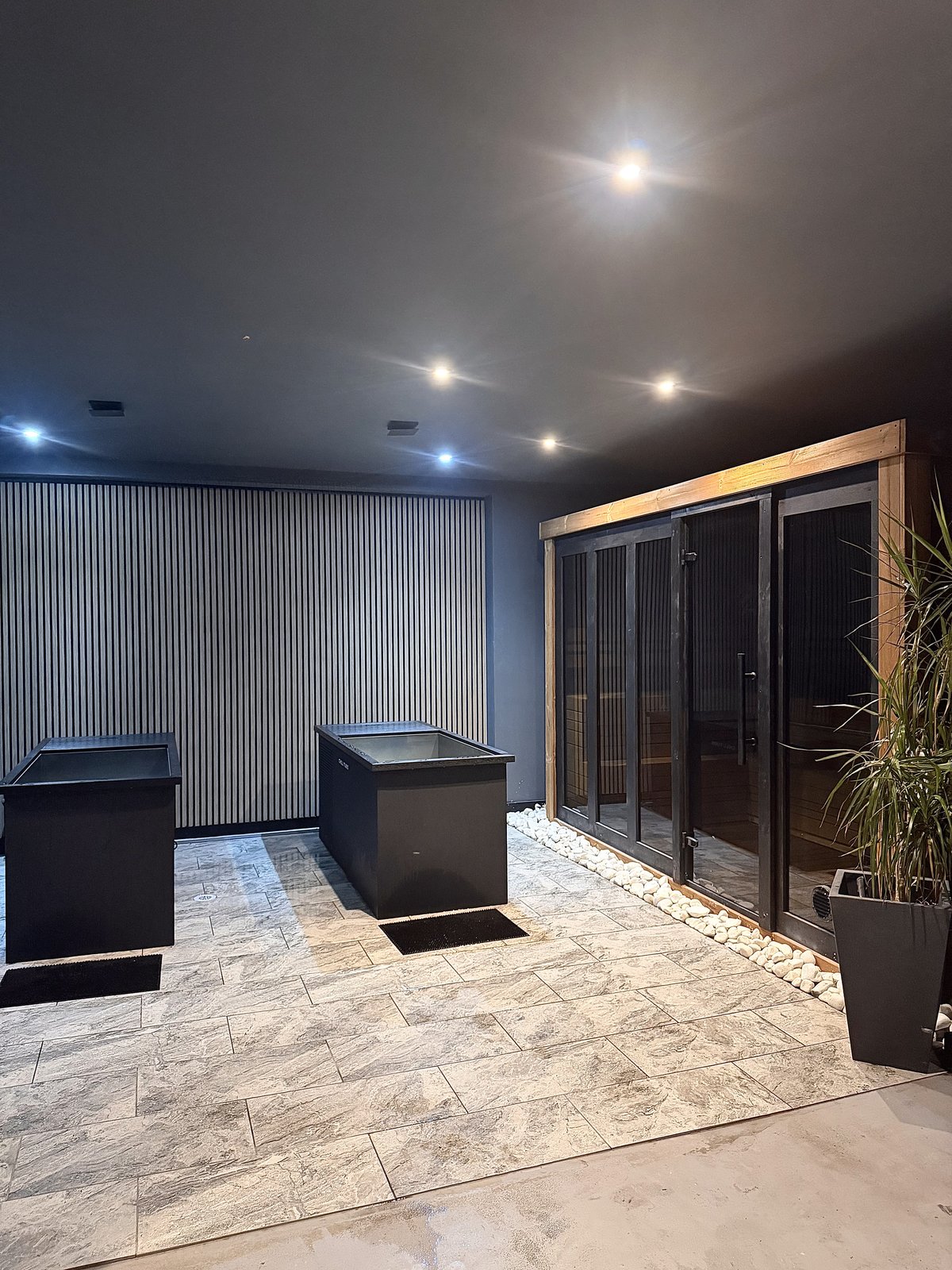
ONE ROOM, BOTH HALVES
Sauna and cold plunge a few steps apart, so the rounds in this protocol take seconds to move between rather than a drive across town.
THE PHYSIOLOGY
What happens to the body during contrast therapy
Each temperature transition triggers a distinct physiological response. Here is what the body is doing at each stage — no claims beyond the established response.
Vasoconstriction
On entering cold water, peripheral blood vessels narrow rapidly. Blood is redirected to the core to protect vital organs. This is involuntary and happens within seconds of immersion.
Vasodilation
On entering heat — or on exiting the cold — blood vessels reopen and oxygenated blood floods back into peripheral tissue. Metabolic waste products (including lactate) are cleared more efficiently than in passive rest.
Norepinephrine release
Cold exposure reliably produces a large norepinephrine surge — the same neurochemical involved in alertness and focus. Most people feel sharp and clear-headed immediately after a cold plunge. The effect peaks around 2–3 minutes of immersion.
Parasympathetic shift
After the session ends, as core temperature normalises, the body moves into a pronounced parasympathetic state: heart rate drops below resting, cortisol falls, and most people feel calm and tired — in a good way — for several hours. Sleep quality is commonly reported as improved.
Sauna and cold plunge in one room in Altrincham, 90-minute sessions.
Book a session — £20IN PRACTICE
What a contrast therapy session looks like
There is no single prescribed protocol, but the most commonly used format for recovery is: 10–15 minutes in the sauna, followed by 2–3 minutes in cold water immersion, with 3–4 rounds completed in a single session.
At RE:UP, sessions are 90 minutes and free-flow — there is no instructor timing you or directing your schedule. Most people settle into 3–4 rounds naturally within that window. Staff are on hand if you want guidance, but the session is yours to run at your own pace.
If it is your first time, start with one or two rounds and shorter cold dips — 60 seconds is enough to start the response. Most people find their comfortable rhythm within 3–4 sessions.
01
Sauna — 10–15 minutes
The Finnish sauna runs at 90–110°C and is included in every session at RE:UP. Heat raises core temperature, relaxes muscle tissue, and opens blood vessels in preparation for the cold.
02
Cold plunge — 2–3 minutes
Cold water immersion at 4–7°C. Vasoconstriction kicks in within seconds. The norepinephrine response builds over the first 1–2 minutes. Controlled breathing makes the cold far more manageable than most people expect.
03
Repeat — 3 to 4 rounds
Return to heat, allow the body to warm and blood vessels to reopen, then back to cold. Each round reinforces the vascular pumping effect. Most people do 3–4 rounds in 90 minutes.
04
Finish on cold
Most protocols end on cold. It leaves the body in a calm, low heart rate state with the norepinephrine response still active. Some people prefer finishing on heat for relaxation. Both are valid.
COMPARISON
Contrast therapy vs cold only, heat only, and compression
Each recovery modality does something different. They are not interchangeable, and combining them is not always additive — but understanding what each one does helps you use your session time well.
Cold water only
What it does
Vasoconstriction, norepinephrine response, reduces acute inflammation. Effective on its own for post-match or post-event recovery.
Limitation
Misses the vasodilation half of the cycle. No vascular pumping effect. The clearance of metabolic waste is less efficient than with contrast.
Good. Contrast is better for recovery volume over a training block.
Heat only
What it does
Cardiovascular strain (comparable to light exercise), relaxes muscle tissue, improves mood. Useful on rest days and for general wellbeing.
Limitation
No vasoconstriction response. Does not produce the vascular pump. Does not trigger norepinephrine at the same level as cold exposure.
Good for relaxation and cardiovascular adaptation. Weaker for acute recovery than contrast.
Compression (Normatec)
What it does
Mechanical pressure on venous return. Reduces swelling in limbs after intense effort. Passive — you sit still while it works.
Limitation
No cardiovascular challenge. No systemic effect. Works locally on limbs, not on core temperature or neurochemistry.
Complements contrast therapy. RE:UP includes both in every session.
THE PROTOCOL
How long, how cold, and how often
10–15 min
Sauna per round
90–110°C Finnish sauna
2–3 min
Cold plunge per round
At 4–7°C. Build from 60 sec.
3–4 rounds
Per session
In a 90-minute free-flow session
How often to go
For athletes in heavy training, 2–3 sessions per week produces consistent recovery benefit. For general maintenance or stress management, once per week is meaningful. There is no strong evidence against daily use in healthy adults — the subjective intensity of the cold does become milder as the body adapts, but the physiological response remains.
Timing around training
For endurance training (running, cycling, swimming), a contrast session on the same day as your workout is fine and speeds recovery. For heavy strength work, there is modest evidence that very frequent immediate post-lift cold immersion may blunt some hypertrophy signalling — leaving a few hours between a hard weights session and the cold plunge is reasonable. For most recreational gym users, the effect is small enough to ignore.
You need both halves in the same room to run this properly. Ours are a few steps apart.
Book a session — £20WHO USES IT
Who uses contrast therapy and why
Runners and endurance athletes
The most consistent users. Heavy mileage accumulates systemic fatigue and local muscle damage that contrast therapy clears efficiently. Common routine: long run on Sunday, contrast session same afternoon or the following morning. Members doing marathon training typically come in twice a week during peak blocks.
Team sport players
Used within 24 hours of a match or competition. Rugby, football, and cricket players commonly book the morning after a game. The vascular pump clears lactate and reduces DOMS fast enough to allow full training to resume within 48–72 hours rather than the usual 96.
Gym users and strength athletes
Primarily for DOMS management and recovery between sessions. The nuance around cold and hypertrophy applies here — but for most recreational gym users training 3–5 times per week, the recovery benefit of contrast therapy outweighs any marginal effect on muscle growth.
People using it for stress and sleep
No sports background required. The norepinephrine spike from cold exposure followed by the parasympathetic recovery phase produces a reliable mood and sleep effect that many non-athletes find more valuable than any physical recovery benefit. Once or twice a week, consistently, is enough.
SAFETY
Is contrast therapy safe? Who should avoid it.
Contrast therapy is suitable for most healthy adults. The following groups should speak to their GP before using the sauna or cold plunge.
- Cardiovascular disease or a recent cardiac event
- Uncontrolled high blood pressure
- Raynaud's disease or other cold sensitivity conditions
- Pregnancy
- Active open wounds or skin infections in the areas to be immersed
- Epilepsy
- Medications that affect thermoregulation or cardiovascular response (check with your GP)
If you feel faint, dizzy, or short of breath at any point during a session, exit immediately. RE:UP staff are on site during all sessions.
CONTRAST THERAPY IN ALTRINCHAM
Run the full protocol in one room
Sauna and ice bath sit side by side, so the hot-cold rounds this guide describes take seconds to move between rather than a drive across town.
One session is £20. If you are coming more than once a month, a membership costs less per visit:
Essential
£50 /month
Four recovery sessions a month
£12.50 a visit
Unlimited
£65 /month
Unlimited sessions, up to two a day
About £7.50 a visit at twice a week
Unlimited Plus
£100 /month
Unlimited sessions plus a sports massage each month
Includes a £30 massage every month
20 Huxley Street, Broadheath, Altrincham, WA14 5EL · Open 7 days, 7am–9pm
Related guides
RE:UP Altrincham offers full contrast therapy — an 8-person Finnish sauna and cold plunge ice baths under one roof. Book a contrast therapy session from £20 →
QUESTIONS
Common questions about contrast therapy
Contrast therapy is the deliberate alternation between heat and cold — typically a sauna followed by cold water immersion, repeated in rounds. The temperature shift drives repeated cycles of vasoconstriction (blood vessels narrowing in the cold) and vasodilation (blood vessels widening in the heat). This vascular pumping effect is used to accelerate physical recovery after training or competition.
There is consistent evidence that contrast water therapy reduces perceived muscle soreness (DOMS) and accelerates subjective recovery in the 24–72 hours after exercise, particularly for endurance and team sport athletes. It also reliably produces a norepinephrine spike from cold exposure, which most people experience as improved alertness and mood. For strength athletes, very frequent immediate post-session cold immersion may reduce some hypertrophy signalling — but for most recreational gym users this effect is small and practically irrelevant.
Most protocols use 10–15 minutes in the sauna per round. RE:UP's Finnish sauna runs at 90–110°C. At these temperatures, 10 minutes is enough to elevate core temperature and prime the vascular system for the contrast effect. Staying longer does not add meaningful benefit once you are fully heated.
For contrast therapy, 2–3 minutes in the cold plunge per round is typical. At 4–7°C — the temperature RE:UP's baths are maintained at — this is sufficient to produce full vasoconstriction and the norepinephrine response. If you are new to cold exposure, start with 60 seconds and build over several sessions. There is no benefit to pushing beyond what you can manage with controlled breathing.
Most people do 3–4 rounds (sauna → cold → sauna → cold) in a 90-minute session. Research protocols typically use 3–5 rounds. There is no strong evidence that more rounds produce meaningfully better outcomes — what matters is completing the temperature transition, not maximising total rounds.
Start with the sauna. Heat first relaxes the muscles, opens blood vessels, and primes the cardiovascular system for the contrast effect. Finishing on cold is generally preferred — it leaves the body in a calm, recovered state with lower heart rate and the norepinephrine still elevated. Some experienced users finish on heat for relaxation purposes. There is no single correct approach.
Alternating between a sauna and an ice bath is called contrast therapy — also known as contrast water therapy or hot-cold therapy. The term refers specifically to the repeated alternating pattern (sauna, then cold plunge, in rounds) rather than either exposure on its own.
No. Cold water immersion (CWI) means getting into cold water only, without alternating heat. Contrast therapy specifically means alternating between hot and cold. The two share the cold component but contrast therapy produces an additional vascular pumping effect through the repeated transitions that CWI alone does not achieve.
For athletes in heavy training, 2–3 times per week is common. For general recovery or maintenance, once per week produces a meaningful effect. There is no strong evidence against daily use in healthy adults, though the subjective "shock" effect of cold does become milder over time as the body adapts.
Contrast therapy is suitable for most healthy adults. You should not use it if you have a cardiovascular condition, uncontrolled high blood pressure, Raynaud's disease, pregnancy, active open wounds, or epilepsy — or if you are on medication that affects temperature regulation. If in doubt, speak to your GP before booking.
Cold exposure reliably produces a norepinephrine surge — the same neurochemical involved in alertness and focus. After the session, as core temperature normalises, many people experience a pronounced parasympathetic shift: reduced heart rate, lowered cortisol, and improved sleep quality that night. This effect is consistent and is one of the main reasons non-athletes use contrast therapy regularly.
RE:UP Altrincham at 20 Huxley Street, Broadheath offers contrast therapy sessions combining an 8-person Finnish sauna (90–110°C) with two cold plunge baths maintained at 4–7°C. 90-minute free-flow sessions from £20. Open seven days a week, 7am to 9pm.