
Recovery Guide · RE:UP Altrincham
Sauna for Heat Tolerance
Regular sauna exposure after training builds the same heat adaptations as training in hot weather. Your blood volume rises, you sweat sooner and lose less sodium, and your heart rate at a given effort comes down. Most of it happens in two to three weeks, and most of it is gone again a fortnight after you stop.
Published ·Last reviewed
What is heat tolerance, and why train it?
Heat tolerance is how well you hold your performance together when your body is struggling to stay cool. Anyone who has run a race on an unexpectedly warm day knows what poor heat tolerance feels like. The pace that felt easy in training becomes a fight, your heart rate climbs for no obvious reason, and the last few miles disappear.
The body adapts to that stress if you give it the stress often enough. Traditionally that meant training in the heat, which is awkward advice in Greater Manchester. Heat exposure after training does most of the same job. You are not adding training load, you are adding a heat signal on top of work you were doing anyway.
This matters for more than hot-weather racing. The blood volume changes that come with heat adaptation are the same ones distance runners chase with altitude work, and they show up in cool conditions too. That is the interesting part of the research, and also the part where effect sizes vary a lot between studies.
RE:UP Altrincham's sauna holds 90–110°C, with cold plunges for the recovery half.
Book a session — £20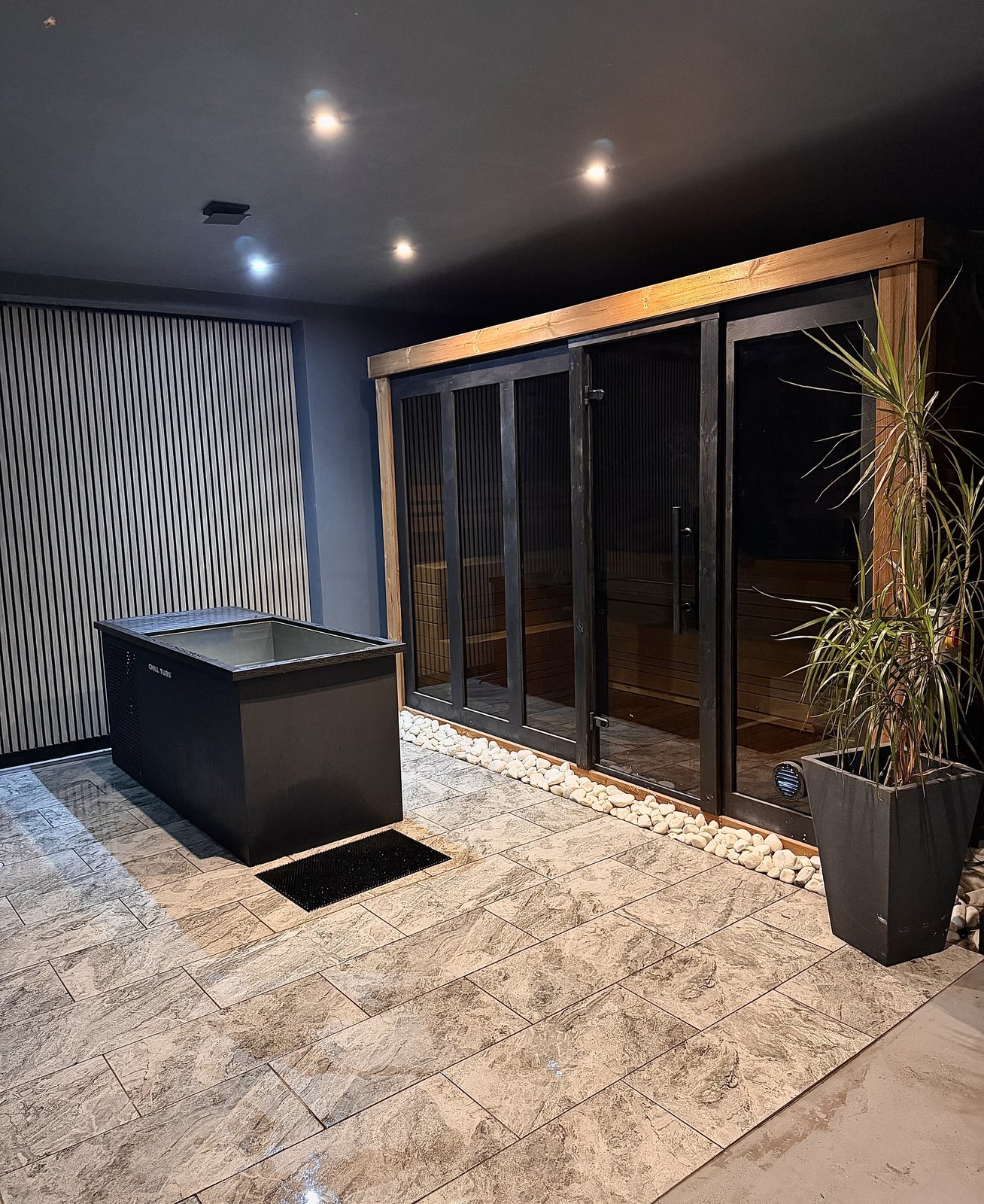
HEAT TRAINING HERE
Heat adaptation needs real temperatures held for real time, then somewhere to cool down properly. The sauna runs 90–110°C and the plunges sit a few steps away.
THE ADAPTATIONS
What changes in the body
More blood plasma
Plasma volume rises within the first week or so. More circulating blood means your body can supply working muscle and send blood to the skin for cooling at the same time, instead of choosing between the two.
Earlier sweating
You start sweating at a lower core temperature. Cooling begins sooner in a session rather than after you are already overheating, which is why a hot run stops feeling like a wall you hit at 40 minutes.
More dilute sweat
Adapted sweat carries less sodium. You keep more electrolyte for the same volume of fluid lost, which makes long efforts in the heat easier to fuel and hydrate for.
Lower heart rate and core temperature
At the same pace and the same air temperature, your heart rate and core temperature settle lower than before. This is the change most people actually notice, because the effort feels different.
THE PROTOCOL
A practical heat adaptation block
This is the shape most of the research points at. Treat it as a starting structure, not a prescription, and build up rather than beginning at the top end.
Block length
Three weeks, 10 to 14 exposures in total. Three or four sessions a week is the usual shape. Shorter blocks give you some of the blood volume change but not much of the sweating adaptation.
Timing
Straight after training, while your core temperature is still up. Ten to fifteen minutes between finishing and getting in is fine. Avoid using the sauna before a session you care about.
Duration and temperature
15 to 30 minutes at 80 to 100°C. Build up. If you are new to heat work, start at 10 to 15 minutes and add a few minutes per session rather than jumping straight to half an hour.
Hydration
Weigh yourself before and after for the first few sessions if you want a real number. Replace roughly 1.5 times the fluid you lost across the rest of the day, with some sodium in it, not all in one go.
Timing it to a race
Finish the block in the last two weeks before the event. Adaptation decays quickly, so a heat block done two months out has largely worn off by race day.
Maintenance
One or two exposures a week is usually enough to hold most of what you built. That is a much smaller commitment than starting from scratch again.
Heat adaptation needs a sauna that actually holds temperature. Ours runs 90–110°C, seven days a week.
Book a session — £20THE HONEST VERSION
What the evidence does and does not support
Heat adaptation itself is well established. Repeated heat exposure reliably raises plasma volume, brings on sweating earlier and lowers heart rate at a given workload. That part is not controversial.
The claim that deserves more caution is the performance one, particularly in cool conditions. Some studies in trained runners have found meaningful improvements in endurance after a few weeks of post-training sauna. Others have found small or inconsistent effects. The studies are mostly small, and the protocols vary enough that comparing them is difficult. It is fair to say heat work is promising and low cost. It is not fair to promise anyone a time.
The decay is the part people most often get wrong. A heat block is not something you bank. If your event is in October, do the work in September, not in July.
Related guides
- Sauna Benefits: What the Evidence Says
- Sauna and Ice Bath in Altrincham: Your First Session
- What Is Contrast Therapy?
- Marathon Recovery: Race Day and Beyond
RE:UP Altrincham runs an 8-person Finnish sauna at 90–110°C, cold plunge ice baths at 4–7°C, Normatec compression and Level 5 qualified sports massage. See sauna details and book a session
QUESTIONS
Heat tolerance questions, answered
Yes. Sitting in a hot room raises your core temperature and makes you sweat, which is the same signal that training in hot weather gives your body. Repeat that signal often enough and the body adapts. You start sweating sooner, your blood volume goes up, and your heart rate at a given effort comes down. The useful part is that you get the adaptation without having to travel somewhere hot or train harder than your plan allows.
Most of the change happens in the first two to three weeks of regular exposure. Blood volume tends to move first, often within a week. The sweating changes and the lower heart rate follow over the next fortnight. Full adaptation is usually described as taking around 10 to 14 exposures, so three or four sessions a week for three weeks is a sensible block.
Four things matter most. Blood plasma volume increases, which means more blood available to both your muscles and your skin. You begin sweating at a lower core temperature, so cooling starts earlier. Your sweat becomes more dilute, so you lose less sodium. And your heart rate and core temperature sit lower at the same workload. Together those changes are why the same run feels easier in the heat after a few weeks of exposure.
Around 15 to 30 minutes at 80 to 100°C, done straight after training rather than on a rest day. Start at the short end. If you are new to it, 10 to 15 minutes is a fair first session, and you build from there. The aim is a genuine rise in core temperature held for a while, not a competition to see who can sit longest.
After. Your core temperature is already up when you finish a session, so the sauna extends that heat stimulus rather than starting from cold. Going in beforehand leaves you dehydrated and tired for the work that actually matters. The one exception is a deliberate short exposure on a rest day if you are trying to keep an adaptation topped up.
Faster than most people expect. The adaptation starts decaying within a few days of the last exposure and much of it is gone in two to three weeks. Blood volume is usually the first thing to drop back. If you are building heat tolerance for a specific race, finish the block close to the event rather than months out, and keep one or two exposures a week going in between.
Not quite, but it is close enough to be worth doing, and it is far more practical in a British autumn. Training in the heat has the advantage of combining the heat stress with the exact movement you are training for. Post-training sauna gives you most of the same blood and sweating adaptations without adding training load, which is the point for anyone already at the limit of what their week can absorb.
No, and the two get confused. A heat tolerance test is a formal assessment used in military and occupational medicine to decide whether someone can safely return to duty after a heat illness. It is done under medical supervision on a treadmill in a controlled chamber. Building heat tolerance through sauna use is training, not a test, and nothing on this page is a substitute for medical clearance after heat illness.
Anyone who is pregnant, has a heart condition, has low or unstable blood pressure, or is unwell should speak to a doctor before starting. The same goes for anyone who has had heat exhaustion or heat stroke. Alcohol and sauna do not mix. If you feel dizzy, sick or your heart is racing in a way that does not settle, get out and cool down.
HEAT TRAINING IN ALTRINCHAM
A sauna hot enough to train in
Heat adaptation needs real temperatures held for real time. The sauna runs at 90-110°C dry heat, with cold plunges next to it for the recovery half of the session.
One session is £20. If you are coming more than once a month, a membership costs less per visit:
Essential
£50 /month
Four recovery sessions a month
£12.50 a visit
Unlimited
£65 /month
Unlimited sessions, up to two a day
About £7.50 a visit at twice a week
Unlimited Plus
£100 /month
Unlimited sessions plus a sports massage each month
Includes a £30 massage every month
20 Huxley Street, Broadheath, Altrincham, WA14 5EL · Open 7 days, 8am–9pm