
Recovery Guide · RE:UP Altrincham
Cold or Heat for a Calf Strain That Keeps Coming Back?
Heat, for comfort — it relieves soreness both within and beyond 24 hours, where cold only works inside the first 24. But neither changes recurrence. The question that actually matters is when you use cold, because routinely plunging straight after a loading session may blunt the adaptation you are trying to build.
For the capacity problem underneath it, see injury rehab at RE:UP or the guide on massage versus rest.
The short answer
If you are choosing between them on symptoms, heat. If you are hoping one of them stops the calf going again, neither — that is a capacity problem and it is solved by loading, not by temperature.
The genuinely useful finding on this page is about sequence rather than selection. There is good evidence that cold water immersion immediately after resistance training interferes with part of the adaptive response — which matters a great deal if the whole point of your week is making the calf more tolerant.
On symptoms, heat has the edge
A 2021 meta-analysis in Physical Therapy in Sport pooled 32 randomised controlled trials covering 1,098 participants and compared heat and cold for delayed onset muscle soreness. Cold applied within an hour of exercise reduced pain within the first 24 hours and had no clear effect beyond it. Heat reduced pain both within 24 hours and after 24 hours, and the largest single effects in the analysis came from hot packs.
The difference between heat and cold overall was not statistically significant, so this is a lean rather than a verdict. A 2015 review in Postgraduate Medicine pointed the same way, noting randomised trials in which heat-wrap therapy gave significantly greater relief of muscle soreness than cold therapy did.
Heat also does something cold cannot: it increases the elasticity of connective tissue. For a calf you are about to load through range, that is a practical advantage, which is why heat before rehabilitation work tends to be more useful than cold after it.
Both, used deliberately
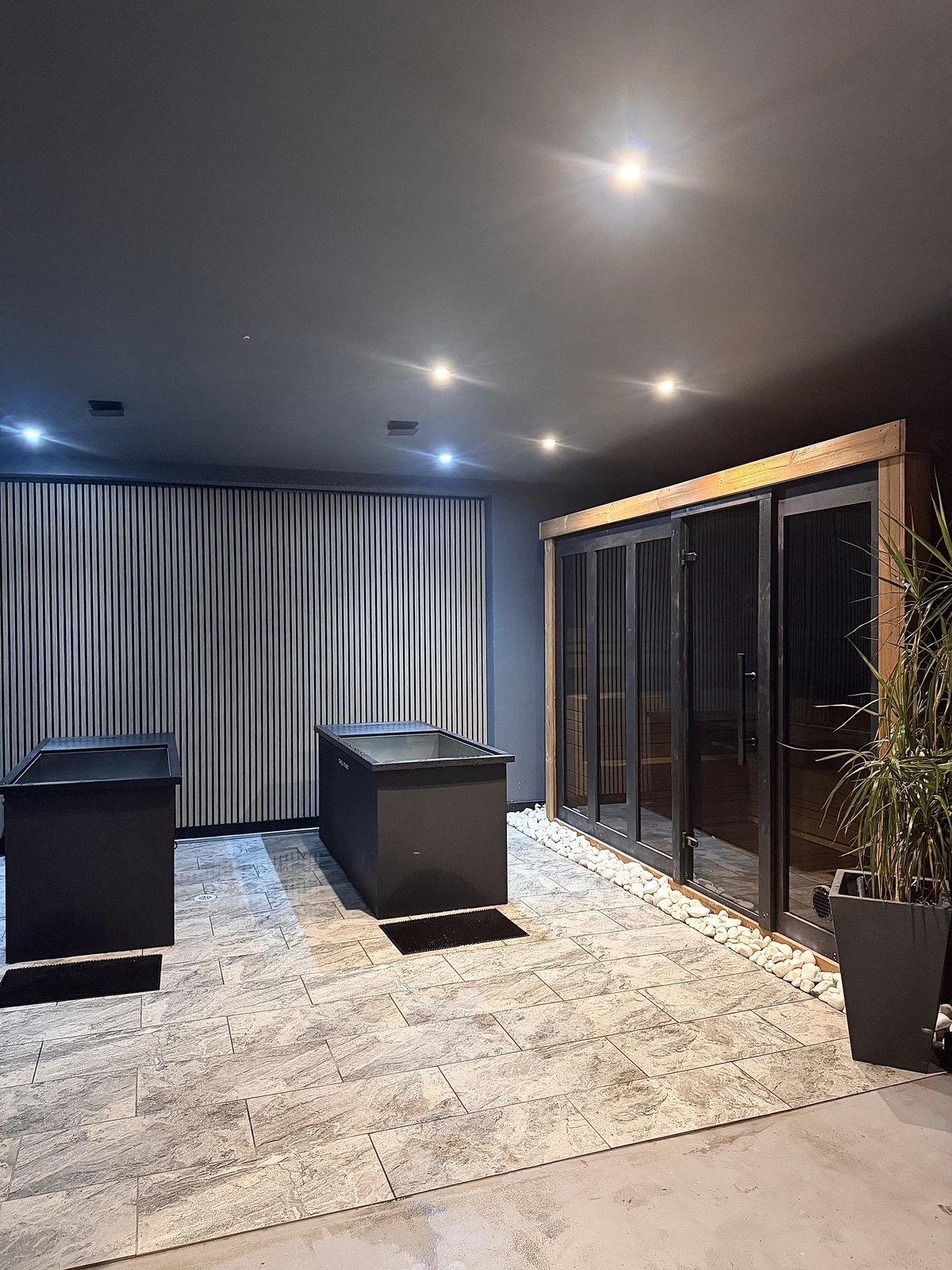
The 8-person Finnish sauna and cold plunges at RE:UP Altrincham. Heat before loading work, when stiffness is limiting range. Cold on days you are not trying to build calf capacity — the sequence matters more than the choice.
The finding that should change what you do
A 2019 study in the Journal of Applied Physiology examined what happens when cold water immersion is used routinely after whole-body resistance training. It found that cold water immersion attenuated anabolic signalling and skeletal muscle fibre hypertrophy — but, importantly, strength gain was not reduced. A separate 2019 randomised trial in the European Journal of Applied Physiology found cold water immersion blunted and delayed post-exercise increases in circulating testosterone and cytokines.
Read carefully, this is a timing instruction, not a prohibition. Fibre growth was blunted; strength was not. That is a reason to separate your cold exposure from your loading sessions, and not a reason to stop using the plunge.
Applied to a recurring calf: the loading sessions are the intervention, and the hours immediately after them are when the muscle is responding to that stimulus. Dropping into 4–7°C water at that exact moment is the one time in the week it is least useful. Use the plunge on other days, or well separated from the session, and use it for what it is genuinely good at — keeping you comfortable enough to train consistently across a week.
It is worth being clear about the limits of this evidence too: it comes from resistance training studies, not from trials of people rehabilitating calf strains. The reasoning transfers, the data does not directly.
A calf that has gone more than once is a capacity problem. RE:UP's injury assessment is £60, follow-ups from £40.
See injury rehabWhat recurrence actually needs
A 2022 study interviewed twenty expert sports clinicians working in elite sport about how they assess, manage and prevent calf muscle strain injuries. Their answer to prognosis was not an intervention at all: ongoing monitoring of calf capacity and its response to loading exposure gives the most accurate estimate of how things will go.
The same study concluded that a universal injury prevention programme for calf strain may not exist, and that strategies should be individualised to the athlete and the demands of their sport. It also opened by noting a dearth of research to guide clinicians in this area — worth knowing before trusting anybody, this page included, who speaks about calf strain with total confidence.
Nothing in that body of work involves a temperature. Cold and heat manage how the calf feels. Whether it strains again depends on what it can tolerate and on whether you returned to running before it could.
Important
Do not apply heat or use a sauna on a calf that is swollen, hot, red or painful without a clear injury. That presentation can indicate a blood clot and needs prompt medical assessment, not recovery work. Equally, a snap at the back of the ankle with an inability to push off may be an Achilles injury and should be assessed.
Cold, heat and recurring calf strain — answered
For comfort, heat is the better bet — a 2021 meta-analysis of 32 randomised controlled trials found cold reduces soreness only within the first 24 hours while heat reduces it both within and beyond 24 hours, and a 2015 review found heat-wrap therapy gave significantly greater relief of muscle soreness than cold in randomised trials. But for recurrence specifically, neither changes anything. A calf that keeps straining has a capacity problem, and temperature does not alter capacity. The more consequential question is not which one you use but when — because routinely cold-plunging straight after your loading sessions may work against the adaptation you are trying to build.
There is reasonable evidence that routine post-exercise cold blunts some of the adaptive response to training. A 2019 study in the Journal of Applied Physiology found that cold water immersion attenuated anabolic signalling and skeletal muscle fibre hypertrophy following whole-body resistance training — although, importantly, strength gains were not reduced. A separate 2019 randomised trial found cold water immersion blunted and delayed post-exercise increases in circulating testosterone and cytokines. If the purpose of your calf programme is to build the muscle’s tolerance, cooling it immediately after every session is at best neutral and may cost you some of the adaptation.
No — just separate it from your loading sessions. The nuance in that 2019 finding matters: fibre hypertrophy was blunted but strength gain was not, so this is not a reason to abandon cold water immersion. Use it on days when you are not doing calf rehabilitation, or several hours after rather than immediately, and use it for what it is good at — managing soreness and training load across a week. What it should not be is the fifteen minutes immediately following the session that was meant to make your calf stronger.
It helps the symptoms, and it has a slightly longer-acting effect on soreness than cold does. Heat increases blood flow, tissue metabolism and the elasticity of connective tissue, which is why many people find a sauna or warm shower useful before calf loading work rather than after it — warm tissue moves through range more comfortably. That is a practical benefit for getting the rehabilitation done. It is not a treatment for the underlying problem.
Rebuilding capacity and timing the return on what the calf can demonstrate rather than on how it feels. A 2022 study interviewing 20 expert sports clinicians in elite sport found that ongoing monitoring of calf capacity and its response to loading exposure gives the most accurate estimate of prognosis. The same study concluded that a universal injury prevention programme for calf strain may not exist and that strategies should be individualised — which is an argument for assessment rather than for following a protocol off a website.
None that this page is aware of. The research on cold and heat concerns pain, soreness and recovery of performance after exercise. Recurrence of calf strain is a separate question, studied through loading, capacity and return-to-play decisions. Nobody has shown that a temperature applied to a calf changes how likely it is to strain again, and any page claiming otherwise is extending the evidence beyond what it supports.
Contrast therapy alternates heat and cold in rounds, and it is what a Recovery Session at RE:UP is built around. For a recurring calf the same logic applies as for either alone: it manages how you feel and how you tolerate your training week, and there is no evidence it changes recurrence. If you enjoy it and it helps you keep training consistently, that is a reasonable benefit. RE:UP has a separate guide on what contrast therapy is and what it does.
A practical pattern: keep cold away from the hours immediately after calf loading sessions, and use it on other days or after running when adaptation of the calf musculature is not the goal of that session. Use heat before rehabilitation work if stiffness is limiting the range you can work through. None of this is strongly evidenced as a protocol — it is the sensible reading of what cold and heat do, applied to what you are trying to achieve.
Sports injury assessment and rehabilitation with Level 5 qualified sports therapists — initial assessment £60, follow-ups from £40 — which is the route that addresses recurrence. The facility itself has two cold plunge ice baths at 4–7°C and an 8-person Finnish sauna at 90–110°C in a 90-minute Recovery Session from £20, at 20 Huxley Street, Broadheath, used for managing training load rather than for treating the injury.
If the calf is swollen, hot, red or painful without a clear injury, seek medical advice promptly — a blood clot can present this way and must be ruled out. Do not use heat or a sauna on an unexplained swollen calf. Also seek assessment if you felt a snap at the back of the ankle and cannot push off, which may be an Achilles injury.
Sources
What this page is based on
Every clinical claim on this page is drawn from the peer-reviewed records below, each listed with the PubMed ID so it can be checked. Where the evidence is uncertain, this page says so rather than rounding it up. Guidance here is general information, not a personal diagnosis — if pain is severe, worsening, or follows a specific injury, see a clinician.
1. J Appl Physiol (1985) · 2019
Cold water immersion attenuates anabolic signaling and skeletal muscle fiber hypertrophy, but not strength gain, following whole-body resistance training.
Used here for: the central practical point — that routine cold water immersion after resistance training blunted muscle fibre growth and anabolic signalling, though strength gains were not reduced.
PubMed 315134502. Phys Ther Sport · 2021 · Meta-analysis of 32 randomised controlled trials
Heat and cold therapy reduce pain in patients with delayed onset muscle soreness: A systematic review and meta-analysis of 32 randomized controlled trials.
Used here for: that cold reduces soreness only within the first 24 hours while heat reduces it both within and beyond 24 hours, with no statistically significant difference between the two overall.
PubMed 334939913. Postgrad Med · 2015 · Review
Mechanisms and efficacy of heat and cold therapies for musculoskeletal injury.
Used here for: the physiological effects of each, and the finding that heat-wrap therapy provided significantly greater relief of delayed onset muscle soreness than cold therapy in randomised trials.
PubMed 255262314. Sports Med Open · 2022 · Qualitative study, 20 expert clinicians
The Assessment, Management and Prevention of Calf Muscle Strain Injuries: A Qualitative Study of the Practices and Perspectives of 20 Expert Sports Clinicians.
Used here for: that monitoring calf capacity and its response to loading gives the most accurate prognosis, and that no universal prevention programme for calf strain may exist.
PubMed 350322335. Eur J Appl Physiol · 2019 · Randomised controlled trial
Cold-water immersion blunts and delays increases in circulating testosterone and cytokines post-resistance exercise.
Used here for: supporting evidence that cold water immersion alters the post-exercise signalling environment.
PubMed 31222379
Clinical content last checked against these sources on 2 November 2026.
Recurring calf strain
Time the cold, and rebuild the capacity
Two cold plunges at 4–7°C and an 8-person Finnish sauna in a 90-minute Recovery Session from £20 — used on the right days. For the recurrence itself, RE:UP's injury assessment with Level 5 qualified sports therapists is £60, follow-ups from £40.
One session is £20. If you are coming more than once a month, a membership costs less per visit:
Essential
£50 /month
Four recovery sessions a month
£12.50 a visit
Unlimited
£65 /month
Unlimited sessions, up to two a day
About £7.50 a visit at twice a week
Unlimited Plus
£100 /month
Unlimited sessions plus a sports massage each month
Includes a £30 massage every month
20 Huxley Street, Broadheath, Altrincham, WA14 5EL · Open 7 days, 8am–9pm