
Recovery Guide · RE:UP Altrincham
Sports Massage or Rest for a Recurring Calf Strain?
Neither, as a plan. Rest removes the load provoking the calf — and the load the calf needs to become more tolerant, which is why the strain returns. Massage eases the tightness without changing capacity. The thing that shifts a recurring calf is progressively rebuilding what it can tolerate.
For assessment, see injury rehab at RE:UP. For soft tissue work alongside a plan, see sports massage in Altrincham.
The short answer
The question sets up a choice between two things that are both passive. A calf that has strained more than once has a capacity problem, and neither resting it nor rubbing it changes capacity.
A 2022 study that interviewed twenty expert sports clinicians working in elite sport found that monitoring calf capacity and its response to loading exposure gives the most accurate estimate of prognosis. That is where the attention belongs. Rest and massage are details within a plan, not the plan.
Why a calf keeps going
The common sequence is this: the calf strains, you stop running, it settles, you start running again at something close to the old volume, and within a few weeks it goes again. Nothing about that is unlucky. The calf was never rebuilt to tolerate what you returned it to, and the decision to return was made on how it felt.
Comfort is a poor test. The clearest demonstration comes from the hamstring literature, where a 2016 systematic review and meta-analysis found strength deficits persisting after symptoms had resolved — the same principle applies to a calf that feels fine walking and has never been tested at running loads.
There may be a mechanical contribution too. A 2021 study found that male runners with a history of recurrent calf strain showed different running kinematics from runners without that history, which supports looking at how the calf is being loaded rather than only at the muscle itself.
Start with the assessment
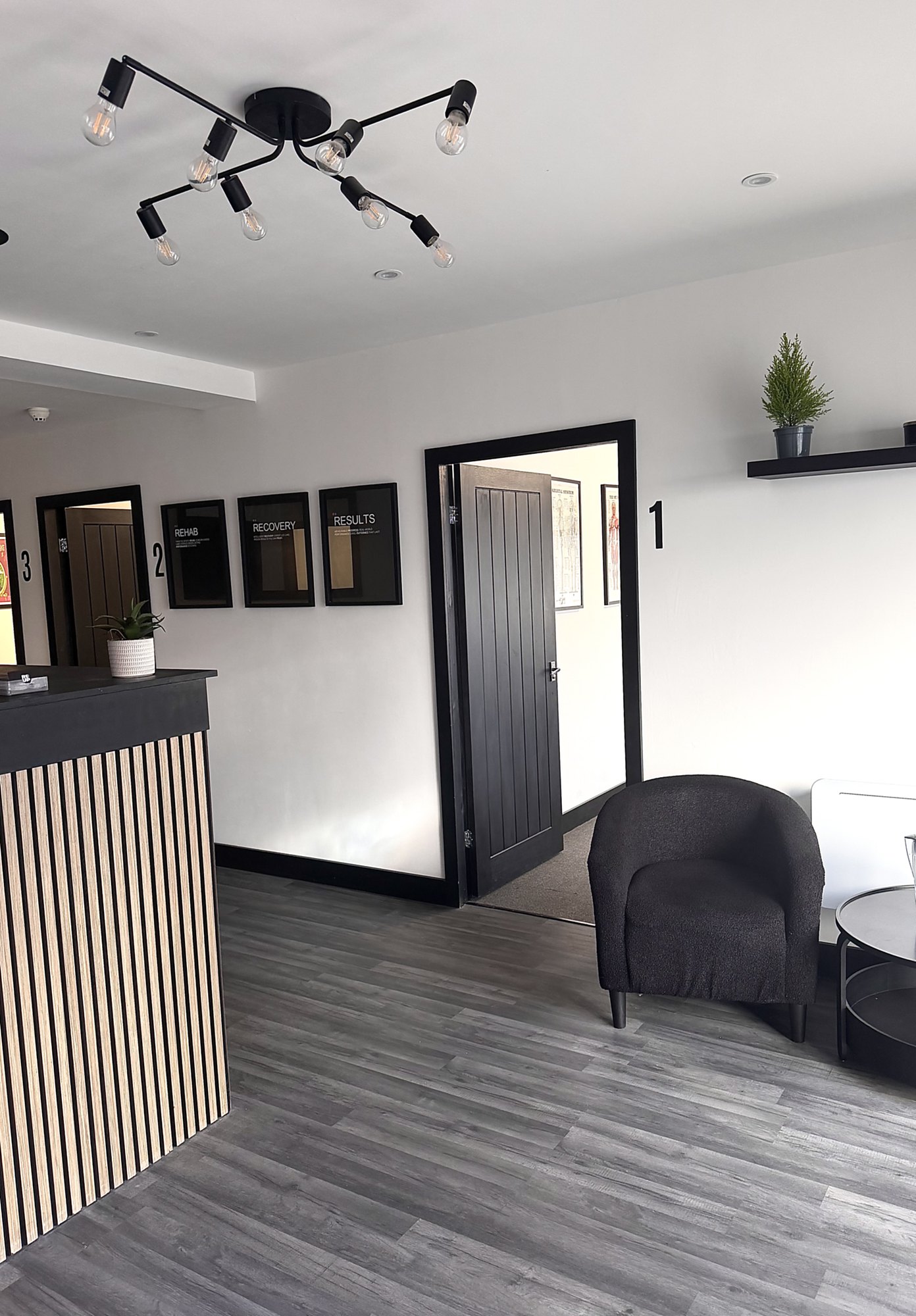
RE:UP Altrincham, 20 Huxley Street, Broadheath. For a calf that has gone more than once, the assessment is the valuable part — establishing current capacity and what is driving the pattern, rather than treating the latest flare.
An honest note on the evidence
The calf is less well studied than you would expect. The 2022 expert study opens by noting a dearth of research to guide clinicians dealing with calf muscle strain injuries, and that is why it was conducted as structured interviews with twenty specialists rather than as a pooled analysis of trials. Anyone presenting calf strain management as a settled science is overstating it.
Two findings from that work are worth carrying. The first is that calf strain injuries were considered to have characteristics unique among muscle strains, so borrowing a hamstring protocol wholesale is not appropriate. The second is the conclusion that a universal injury prevention programme for calf strain may not exist, and that strategies should be individualised to the athlete and the demands of the sport.
Which is an argument for assessment over protocol — and against any page, including this one, that claims to tell you the exercises your calf needs without having seen it.
A calf that has gone more than once is worth assessing properly. RE:UP's injury assessment is £60, follow-ups from £40.
See injury rehabSo where do massage and rest fit?
Relative rest, immediately after an acute strain, while symptoms settle — yes. Backing off the provoking activity is sensible and short-lived. What does not help is prolonged complete rest, because the calf deconditions while you wait and you return with less capacity than you were injured with.
Sports massage, as an adjunct — also yes. It commonly reduces the sensation of tightness, and a calf that feels less tight is easier to load. That is a real contribution. The failure mode is when the massage becomes the whole plan, because the tightness returns on the same schedule as the training that caused it.
The thing in the middle, doing the actual work, is a graded loading programme built from where the calf currently is: calf raise capacity, single-leg work, then a progressive return to running volume and speed, with the return decision made on what the calf can demonstrate rather than on what it feels like.
When calf pain is not a strain
- —The calf is swollen, hot, red or painful without a clear injury — seek medical advice promptly, as a blood clot can present this way and needs ruling out.
- —You felt a sharp blow or snap at the back of the ankle and cannot push off — this may be an Achilles injury.
- —Pins and needles, numbness, or pain that travels from the lower back.
- —Calf pain that comes on predictably with walking distance and eases with rest.
RE:UP Altrincham is not a physiotherapy clinic and does not provide medical diagnosis. It offers sports massage and a separate sports injury assessment and rehabilitation service delivered by sports therapists, who will advise on referral where that is the right step.
Recurring calf strain questions — answered
Neither, as a plan. Rest removes the load that is provoking the calf, which is why it feels like it works — and it also removes the load the calf needs to become more tolerant, which is why the strain returns when you start running again. Massage can reduce the tightness that accompanies a flare but does not change the calf’s capacity either. A 2022 study interviewing 20 expert sports clinicians found that monitoring calf capacity and its response to loading exposure gives the most accurate estimate of prognosis — which tells you where the attention belongs: on progressively rebuilding what the calf can tolerate, with the massage and the rest as supporting details rather than the strategy.
Usually because capacity was never rebuilt to the level the activity demands, and the return to running was timed on how the calf felt rather than on what it could do. Recurrence in calf strain is a recognised pattern, not bad luck — it has been tracked over a decade in elite sport. There may also be a mechanical contribution: a 2021 study found that male runners with a history of recurrent calf strain showed different running kinematics from those without, which supports looking beyond the muscle itself at how you load it.
A short period of reduced load is sensible immediately after an acute strain while symptoms settle. Complete, prolonged rest is not, because deconditioning works against you — the calf gets weaker while you wait, so you return to running with less capacity than you had when you got injured. The useful version is relative rest: back off the provoking activity while actively loading the calf in ways it can tolerate.
It commonly reduces the sensation of tightness for a period, and people find that worthwhile. What it does not do is address why the calf is becoming tight under your training load. If a monthly massage is the only thing in the plan, the tightness reliably returns, because nothing about the calf’s tolerance has changed. Used alongside a loading programme it is a reasonable adjunct; used instead of one it is a recurring expense that manages a symptom.
Expert clinicians consider calf strain injuries to have characteristics that set them apart from other muscle strains, and the research base to guide treatment is notably thinner than for, say, the hamstring. The calf also spans two joints and absorbs very high loads in running, and soleus and gastrocnemius injuries behave differently from one another. That combination — distinctive behaviour, less evidence — is why calf strains are better assessed individually than managed from a generic protocol.
Not a universal one. The 2022 expert consensus study concluded explicitly that a universal injury prevention programme for calf muscle strain may not exist, and that strategies should instead be individualised to the athlete’s characteristics and the demands of their sport. Periodic monitoring is common among expert clinicians, but it is used to inform load management and exercise selection rather than to predict who will get injured.
When the calf has demonstrated it can tolerate the load, assessed rather than counted in days. The principle that catches people out is that strength deficits can outlast symptoms — shown clearly in hamstring injury and the same logic applies here. A calf that feels fine walking has not been tested at running loads. Calf raise capacity, single-leg work and a graded return to running volume and speed are how that gets established.
For comfort, possibly; for healing, there is no good evidence that either changes the outcome of a muscle strain. They manage how you feel, not how the tissue repairs. RE:UP publishes a separate guide on what cold and heat actually do for a recurring calf strain if you want the detail on the evidence there.
Sports injury assessment and rehabilitation with Level 5 qualified sports therapists — initial assessment £60, follow-up sessions from £40. For a calf that keeps recurring, the assessment is the valuable part: establishing current capacity and what is driving the pattern. Sports massage from £30 is available alongside that, and recovery sessions with sauna and ice bath from £20 for managing training load.
If the calf is swollen, hot, red or painful without a clear injury, seek medical advice promptly rather than treating it as a strain — a blood clot can present this way and needs ruling out. Also seek assessment if you felt a sharp blow or snap at the back of the ankle and cannot push off, which may indicate an Achilles injury. Recovery facilities are not the right place for either.
Sources
What this page is based on
Every clinical claim on this page is drawn from the peer-reviewed records below, each listed with the PubMed ID so it can be checked. Where the evidence is uncertain, this page says so rather than rounding it up. Guidance here is general information, not a personal diagnosis — if pain is severe, worsening, or follows a specific injury, see a clinician.
1. Sports Med Open · 2022 · Qualitative study, 20 expert clinicians
The Assessment, Management and Prevention of Calf Muscle Strain Injuries: A Qualitative Study of the Practices and Perspectives of 20 Expert Sports Clinicians.
Used here for: that the research base for calf strain is thin, that monitoring calf capacity and response to loading gives the most accurate prognosis, and that a universal prevention programme may not exist.
PubMed 350322332. Int J Sports Phys Ther · 2021
Kinematic Characteristics of Male Runners With a History of Recurrent Calf Muscle Strain Injury.
Used here for: the observation that runners with recurrent calf strain differ in how they move, supporting the idea that recurrence has a cause beyond the muscle being tight.
PubMed 341235263. BMJ Open Sport Exerc Med · 2025
What is a recurrence? The onset, frequency and time loss impact of recurrent calf muscle strain injuries in elite male Australian football players over a decade.
Used here for: that recurrence is a measurable, recognised pattern in calf strain rather than bad luck.
PubMed 409194064. Br J Sports Med · 2016 · Systematic review and meta-analysis
Hamstring strength and flexibility after hamstring strain injury: a systematic review and meta-analysis.
Used here for: the general principle — demonstrated in hamstring injury — that strength deficits can outlast symptoms, which is why comfort is a poor return-to-running test.
PubMed 27075962
Clinical content last checked against these sources on 2 November 2026.
Recurring calf strain
Rebuild the capacity, not just the comfort
RE:UP Altrincham runs sports injury assessment and rehabilitation with Level 5 qualified sports therapists — £60 initial assessment, follow-ups from £40. Sports massage from £30 alongside a plan, and recovery sessions from £20 for managing training load.
One session is £30. If you are coming more than once a month, a membership costs less per visit:
Essential
£50 /month
Four recovery sessions a month
£12.50 a visit
Unlimited
£65 /month
Unlimited sessions, up to two a day
About £7.50 a visit at twice a week
Unlimited Plus
£100 /month
Unlimited sessions plus a sports massage each month
Includes a £30 massage every month
20 Huxley Street, Broadheath, Altrincham, WA14 5EL · Open 7 days, 8am–9pm