
Recovery Guide · RE:UP Altrincham
Does Sports Massage Help Shin Splints?
There is no good evidence that it does — and shin splints is unusual in that there is no good evidence for much else either. A 2013 systematic review of eleven trials concluded that none were free enough of methodological bias to recommend any treatment examined. Massage eases calf tightness. It is comfort, not a cure.
For assessment and load management, see injury rehab at RE:UP, or the shin splints rehabilitation plan.
The short answer
Shin splints is the condition where the evidence runs out. Most pages on the subject write around that by recommending whatever the author sells. This one is going to say it plainly instead, because the gap changes what you should do.
When there is no treatment with good evidence behind it, the decisions that matter move elsewhere: distinguishing shin splints from a bone stress injury, and managing the training load that is irritating the tibia. Both of those need assessment. Neither of them is a technique applied on a treatment couch.
What the review actually found
A 2013 systematic review in Sports Medicine set out to establish what works for medial tibial stress syndrome — the clinical name for shin splints. It identified eleven trials. Every randomised controlled trial among them carried a high risk of bias, and both non-randomised trials were graded poor quality.
Its conclusion was unambiguous: none of the studies were sufficiently free from methodological bias to recommend any of the treatments investigated.
Within that, extracorporeal shockwave therapy appeared to have the most promise. Low-energy laser therapy, sports compression stockings, lower leg braces and pulsed electromagnetic fields had not been proven effective. And in a finding that sets this condition apart from almost every other running injury, the review also listed stretching and strengthening exercises among the interventions not proven effective for medial tibial stress syndrome.
That last point deserves emphasis, because it inverts the advice that works elsewhere. For patellofemoral pain, for hamstring strain, for Achilles tendinopathy, progressive loading is the intervention with the strongest support. For shin splints, the exercise evidence is weak alongside everything else.
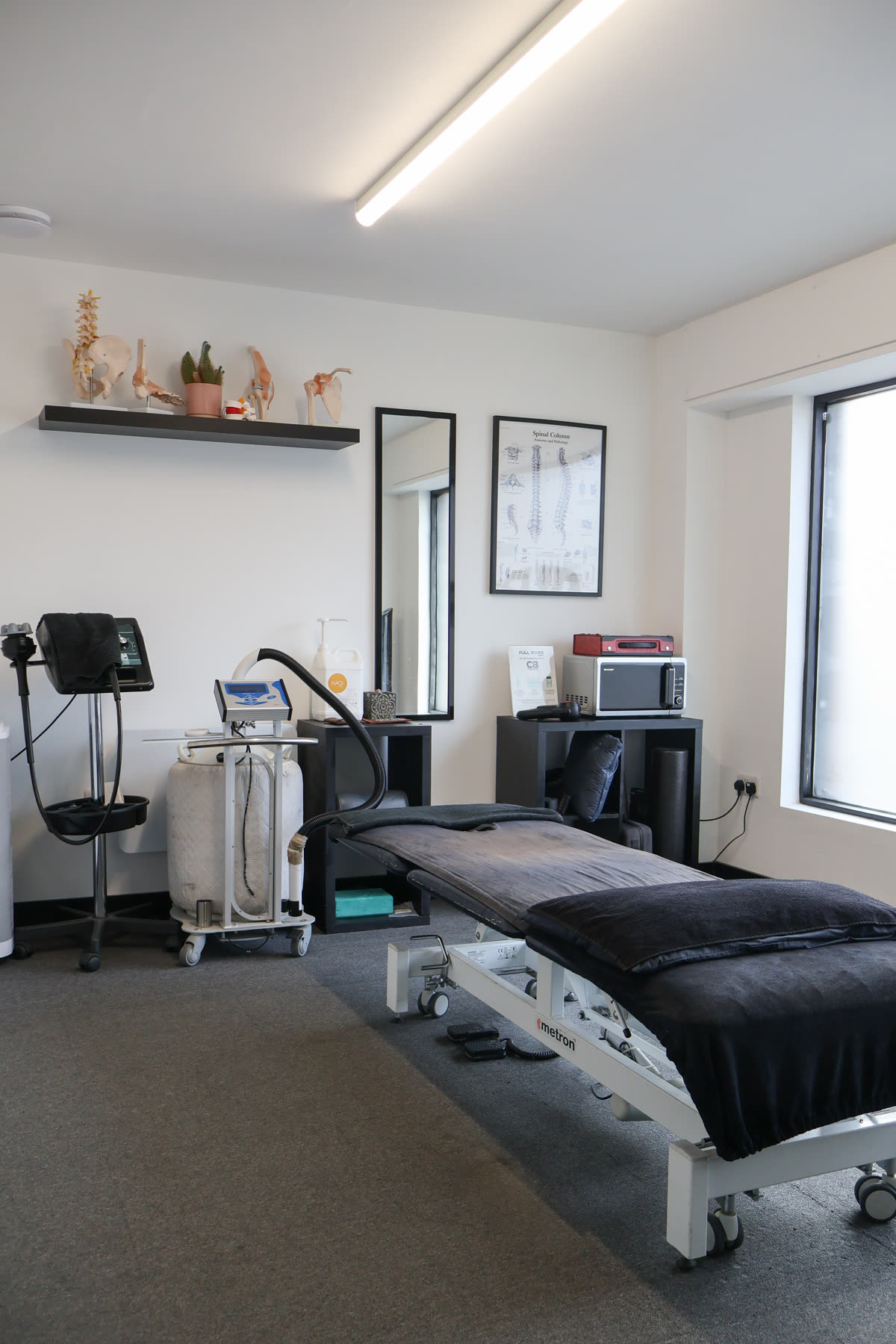
Assessment, not technique
The treatment room at RE:UP Altrincham, 20 Huxley Street, Broadheath. For shin pain the valuable work is distinguishing shin splints from a bone stress injury and getting the training load right — not a treatment applied to the shin.
What to do when the evidence is thin
Weak evidence for treatments does not mean nothing can be done. It means the useful actions are elsewhere, and it means being sceptical of confident claims — including from anyone selling a therapy for shin splints.
In practice the mainstay is load management: reducing the running volume and impact that are irritating the tibia, looking at how quickly training was increased before symptoms began, and rebuilding progressively. That is a scheduling problem more than a treatment problem, which is why assessment is worth more here than any session on a couch.
The second priority is ruling out bone stress injury. Shin splints and a tibial stress fracture sit on the same continuum, and the management diverges sharply: one tolerates reduced running, the other needs genuine offloading and a medical opinion. Getting that distinction wrong in the direction of optimism is how a few weeks becomes a few months.
A 2016 evidence-based review in the Journal of Athletic Training examined the risk factors for medial tibial stress syndrome in active individuals, which is the other half of the picture — understanding why it happened is what stops it recurring when mileage returns.
Shin pain is worth assessing before it is treated. RE:UP's injury assessment is £60, follow-ups from £40.
See injury rehabWhere massage fits, honestly
Shin splints is commonly accompanied by tightness through the calf, and soft tissue work on that musculature is usually comfortable and well tolerated. If it helps you feel better and keeps you consistent with the load management that is actually doing the work, it has earned its place.
There is one caution that matters. Heavy direct pressure along the inner border of the tibia is not appropriate, particularly where the pain is focal rather than spread along the bone. A therapist should know what they are treating before they begin, and should not be working firmly over a shin that could be a developing stress injury.
What massage should not be is the answer to the question “how do I fix my shin splints”. Nothing applied passively to a shin has good evidence behind it, and a course of treatment sold on that basis is being sold ahead of what is known.
When shin pain needs a clinician
- —The pain is sharply focal on the bone — you can point to it with one finger.
- —It worsens as you run rather than easing once you are warm.
- —It hurts at rest, or wakes you at night.
- —There is swelling or a palpable lump over the bone.
- —It followed a sharp increase in training, especially with a history of stress fracture or low energy availability.
RE:UP Altrincham is not a physiotherapy clinic, does not provide imaging, and does not offer medical diagnosis. It provides sports massage and a separate sports injury assessment and rehabilitation service delivered by sports therapists, who will advise on referral where shin pain suggests a bone stress injury.
Shin splints questions — answered
There is no good evidence that it does, and shin splints is unusual in that there is no good evidence for much else either. A 2013 systematic review in Sports Medicine examined eleven trials of treatments for medial tibial stress syndrome — the clinical name for shin splints — and concluded that none of the studies were sufficiently free from methodological bias to recommend any of the treatments investigated. Sports massage can ease the calf tightness that often accompanies shin splints, and people find that worthwhile, but it should be offered as comfort rather than as a cure.
Almost nothing, which is an uncomfortable but honest answer. The 2013 review found that extracorporeal shockwave therapy appeared to have the most promise of the treatments examined, while low-energy laser, compression stockings, lower leg braces and pulsed electromagnetic fields had not been proven effective. Most strikingly, it also listed stretching and strengthening exercises among the interventions not proven effective for this condition — which sets shin splints apart from almost every other running injury, where loading is the backbone of treatment.
Load management is, which is a different thing from a strengthening programme. The weight of clinical practice is on managing the training load that is irritating the tibia — reducing volume and impact, adjusting surfaces and progression rate — rather than on a specific exercise prescription, precisely because the exercise evidence for this condition is weak. That makes shin splints a case where honest assessment and sensible scheduling matter more than any treatment technique, and where a therapist who promises a fix from the couch is overselling.
It can be comfortable and it is generally safe, with one caveat worth taking seriously: heavy direct pressure along the inner shin bone itself is not appropriate, particularly where bone pain is focal rather than diffuse. Work on the calf musculature is a different matter and is usually well tolerated. A therapist should know what they are treating before they start, and should not be pressing hard on a tibia that might be a developing stress injury.
Shin splints typically produces diffuse pain along a length of the inner shin that warms up and eases during exercise. A stress fracture is more often sharply focal — you can usually put one finger on it — tends to worsen through activity rather than ease, and may hurt at rest or at night. That distinction matters because a stress fracture is a bone injury that needs offloading and medical assessment, not massage. If you are unsure which you have, that is a reason to be assessed rather than treated.
It varies widely, and the honest answer is that nobody can give you a reliable figure because the treatment evidence is so thin. What is reasonably consistent in practice is that symptoms settle with reduced load and return quickly when the old training volume comes back too fast. Rebuilding gradually, and judging readiness on how the shin responds to each increase rather than on it being pain-free at rest, is what separates a resolved case from a recurring one.
Often at a reduced volume, though that depends on how irritable the shin is and whether bone injury has been ruled out. The usual approach is to cut back to a level that does not provoke symptoms, maintain fitness through lower-impact work, and rebuild running progressively. Running through worsening shin pain is the route to a stress fracture, which costs far more time than backing off would have.
Sports injury assessment and rehabilitation with Level 5 qualified sports therapists — initial assessment £60, follow-up sessions from £40 — which for shin splints is mainly about assessment, ruling out bone injury, and getting the training load right. RE:UP also publishes a structured shin splints rehabilitation plan. Sports massage from £30 is available for the calf musculature alongside that, and recovery sessions with sauna and ice bath from £20.
No. RE:UP is not a physiotherapy clinic and does not provide imaging or medical diagnosis. It offers sports massage and a separate injury assessment and rehabilitation service delivered by sports therapists. Where shin pain suggests a bone stress injury and needs a scan or a medical opinion, RE:UP’s therapists will say so and advise on the referral pathway rather than treating it.
If the pain is sharply focal on the bone and you can point to it with one finger, if it worsens as you run rather than easing, if it hurts at rest or wakes you at night, if there is swelling over the bone, or if it followed a sudden increase in training in someone with a history of stress fracture or low energy availability. Those features point towards bone stress injury and need assessment, not soft tissue work.
Sources
What this page is based on
Every clinical claim on this page is drawn from the peer-reviewed records below, each listed with the PubMed ID so it can be checked. Where the evidence is uncertain, this page says so rather than rounding it up. Guidance here is general information, not a personal diagnosis — if pain is severe, worsening, or follows a specific injury, see a clinician.
1. Sports Med · 2013 · Systematic review
Treatment of medial tibial stress syndrome: a systematic review.
Used here for: the conclusion that no treatment examined was free enough of methodological bias to be recommended, and the specific finding that stretching and strengthening exercises have not been proven effective for this condition.
PubMed 239799682. J Athl Train · 2016 · Evidence-based review
Risk Factors for Medial Tibial Stress Syndrome in Active Individuals: An Evidence-Based Review.
Used here for: what is established about who develops medial tibial stress syndrome and why.
PubMed 278350433. Br J Sports Med · 2016 · Systematic review and meta-analysis
Hamstring strength and flexibility after hamstring strain injury: a systematic review and meta-analysis.
Used here for: the general principle that capacity can lag behind comfort, which is why a shin that has stopped hurting is not yet a shin ready for its old mileage.
PubMed 27075962
Clinical content last checked against these sources on 2 November 2026.
Shin splints
Assess it, then manage the load
RE:UP Altrincham runs sports injury assessment and rehabilitation with Level 5 qualified sports therapists — £60 initial assessment, follow-ups from £40. Sports massage from £30 for the calf alongside it, and recovery sessions from £20.
One session is £30. If you are coming more than once a month, a membership costs less per visit:
Essential
£50 /month
Four recovery sessions a month
£12.50 a visit
Unlimited
£65 /month
Unlimited sessions, up to two a day
About £7.50 a visit at twice a week
Unlimited Plus
£100 /month
Unlimited sessions plus a sports massage each month
Includes a £30 massage every month
20 Huxley Street, Broadheath, Altrincham, WA14 5EL · Open 7 days, 8am–9pm