
Recovery Guide · RE:UP Altrincham
Does Sports Massage Help Runner’s Knee?
Not on its own. Runner’s knee is patellofemoral pain, and the 2018 international consensus on treating it places manual soft tissue techniques in the uncertainty category while recommending exercise therapy that combines hip and knee strengthening. Sports massage can support that work. It does not replace it.
For assessment and rehabilitation, see injury rehab at RE:UP. For soft tissue work alongside it, see sports massage in Altrincham.
The short answer
Sports massage is not an established treatment for runner’s knee. The evidence that exists supports loading the hip and the knee under a structured programme, and the international consensus explicitly recommends against using mobilisations in isolation.
That is a narrower claim than most pages on this subject make, and it is the honest one. Massage has a role — managing the muscular tightness that accompanies a flare, and making a rehabilitation programme more tolerable — but a knee that keeps hurting needs assessment and progressive loading, not a series of passive treatments.
What runner’s knee actually is
Runner’s knee is the everyday name for patellofemoral pain: pain around or behind the kneecap, provoked by running, stairs, squatting, or long periods sitting with the knee bent. It describes a pattern of symptoms rather than one damaged structure, which is why two people with the same label can need different plans.
It is also common. A 2018 systematic review and meta-analysis in PLoS One put annual prevalence in the general population at 22.7%, and reported an incidence rate among amateur runners of 1,080.5 per 1,000 person-years — a figure above 1,000 because repeat episodes are counted, not because every runner is affected. Recurrence is part of the condition, and that is the single most important thing to understand about treating it: anything that only settles symptoms for a week has not addressed why the knee keeps complaining.
Patellofemoral pain is not a meniscus tear, a ligament injury, or arthritis, and it should not be self-diagnosed when symptoms followed a specific incident. A knee that locked, gave way, or swelled quickly is a different problem and needs looking at.
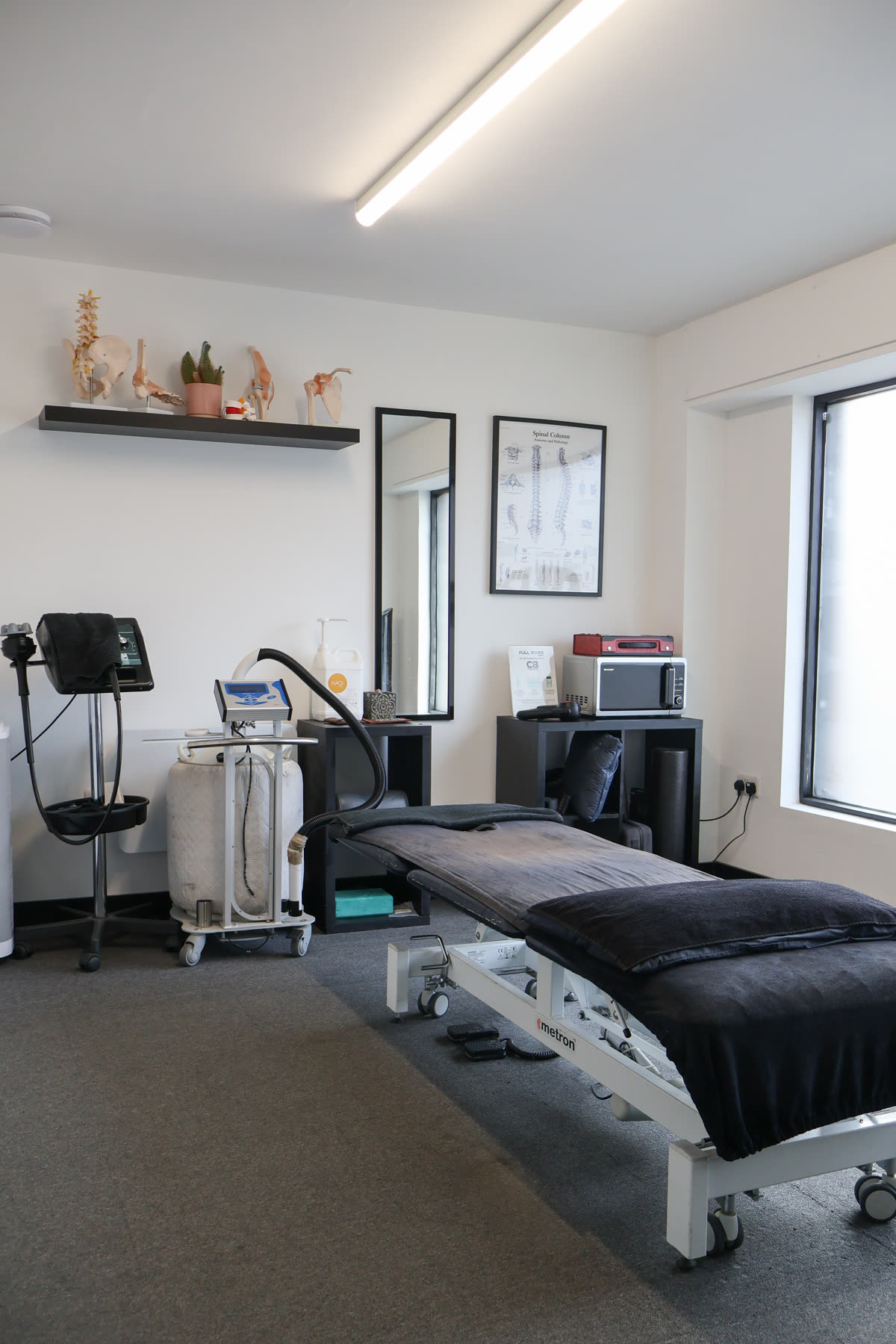
Where assessment happens
The treatment room at RE:UP Altrincham, 20 Huxley Street, Broadheath. Sports injury assessment and rehabilitation is delivered here by Level 5 qualified sports therapists — the appropriate starting point for a knee that keeps flaring, rather than a stand-alone massage.
What the evidence supports — and what it does not
The 2018 consensus statement from the International Patellofemoral Research Retreat, published in the British Journal of Sports Medicine, sorted the available interventions into three groups after a panel of 41 patellofemoral pain experts reviewed the evidence and voted.
Recommended
Exercise therapy, and specifically the combination of hip-focused and knee-focused exercise. Also combined interventions, and foot orthoses.
Uncertain
Manual soft tissue techniques — the category sports massage belongs to. Also patellar taping and bracing, acupuncture and dry needling, blood flow restriction training, and gait retraining. Uncertain means the evidence does not currently settle the question either way.
Not recommended
Patellofemoral, knee or lumbar mobilisations used in isolation, and electrophysical agents.
The case for loading is the strongest part of that picture. A 2018 systematic review with meta-analysis in the Journal of Orthopaedic & Sports Physical Therapy found that strengthening the hip as well as the knee reduced pain and improved activity more than knee strengthening alone, and a multicentre randomised controlled trial published in the Journal of Athletic Training reached a consistent conclusion comparing hip and core work against knee work. A 2024 best-practice guide in the British Journal of Sports Medicine, synthesising a systematic review with patient input and clinical reasoning, keeps exercise at the centre of management.
A knee that keeps flaring needs assessing before it needs treating. RE:UP's injury assessment is £60, with follow-ups from £40.
See injury rehabSo where does sports massage fit?
Alongside a programme, not instead of one. People with patellofemoral pain frequently have tight, overworked musculature around the thigh and hip, and soft tissue work can reduce that tension and make the strengthening work more comfortable to do. Comfort matters more than it sounds: a rehabilitation programme only works if it is completed, and a programme that is painful to perform is one people abandon.
What sports massage should not be is the plan. If the only intervention is a monthly massage, nothing has changed about the capacity of the hip and knee to tolerate running, and the symptoms will return when mileage does. That is the predictable pattern behind most people who describe a knee that “keeps coming back”.
There is also a practical caution. Direct heavy pressure over an irritable kneecap or an inflamed tendon can increase symptoms for a day or two. A therapist should assess the knee before working on it rather than applying a generic routine, and if sessions consistently leave the knee worse rather than better, the plan needs revisiting rather than repeating.
When a knee needs a clinician, not a recovery session
Recovery facilities manage load and comfort. They do not diagnose an injured joint. Seek assessment rather than treatment if any of the following apply:
- —The knee locked, gave way, or swelled rapidly after a specific incident.
- —You cannot put weight through it.
- —There is marked swelling, redness or heat around the joint.
- —Pain wakes you at night.
- —It is getting steadily worse despite reducing your running.
RE:UP Altrincham is not a physiotherapy clinic. It offers sports massage and a separate sports injury assessment and rehabilitation service delivered by sports therapists. Where a knee needs a physiotherapist’s broader clinical scope or a medical opinion, RE:UP’s therapists will say so and advise on the referral pathway.
Runner’s knee questions — answered
Not as a treatment on its own. Runner’s knee is the common name for patellofemoral pain, and the 2018 international consensus statement on patellofemoral pain places manual soft tissue techniques — which is what sports massage is — in its uncertainty category: not recommended against, but not established as effective either. What the same consensus does recommend is exercise therapy, particularly a combination of hip-focused and knee-focused strengthening. Sports massage can sit alongside that work and help with the associated muscle tightness, but it is not the thing that resolves the problem.
Loading. The strongest and most consistent finding across the patellofemoral pain literature is that exercise therapy works, and that programmes combining hip and knee strengthening outperform knee strengthening alone — that was the conclusion of a 2018 systematic review with meta-analysis in the Journal of Orthopaedic & Sports Physical Therapy, supported by an earlier multicentre randomised controlled trial comparing hip and core work against knee work. A structured programme run over weeks is the intervention. Passive treatments are adjuncts to it.
“Runner’s knee” is the everyday term for patellofemoral pain — pain around or behind the kneecap, typically brought on by running, stairs, squatting, or sitting with the knee bent for long periods. It is not a single structural diagnosis and it is not the same as a meniscus tear, ligament injury or arthritis. Because the label covers a presentation rather than one specific tissue, assessment matters before treatment is chosen.
Common enough that it is among the most frequently reported forms of knee pain. A 2018 systematic review and meta-analysis in PLoS One reported an annual prevalence of 22.7% in the general population, and an incidence rate among amateur runners of 1,080.5 per 1,000 person-years — a rate above 1,000 reflects repeat episodes being counted, not that every runner gets it. The practical point is that recurrence is part of the picture, which is why a one-off passive treatment rarely settles it.
Not necessarily, and complete rest is rarely the recommendation. The usual approach is to reduce the load that provokes symptoms — volume, pace, hills, or all three — while a strengthening programme is built up, then reintroduce running progressively. How far to reduce depends on how irritable the knee is, which is a judgement made on assessment rather than from a guide. If pain is worsening week on week despite backing off, that warrants a clinical opinion.
Direct, heavy pressure over an irritable kneecap or inflamed tendon can increase symptoms for a day or two, which is why a therapist should assess before working on the area rather than treating the knee generically. Soft tissue work around the thigh and hip is usually well tolerated. If a session consistently leaves the knee more painful rather than less, that is a signal to stop and reassess the plan, not to push through.
An injury assessment first, not a massage. RE:UP Altrincham runs a sports injury assessment and rehabilitation service with Level 5 qualified sports therapists — initial assessment £60, follow-up sessions from £40 — which is the appropriate starting point for a knee that keeps flaring. Sports massage from £30 is available and can be useful alongside a rehab plan for the surrounding muscle, but RE:UP would not offer it as the treatment for patellofemoral pain on its own.
No. RE:UP is not a physiotherapy clinic. It offers sports massage and a separate injury assessment and rehabilitation service delivered by sports therapists. If a knee needs the broader clinical scope of a physiotherapist or a medical opinion — for example where a structural injury is suspected — RE:UP’s therapists will say so and advise on the right referral pathway.
If the knee locked, gave way, or swelled rapidly after a specific incident; if you cannot bear weight; if there is marked swelling, redness or heat; if pain wakes you at night; or if it is steadily worsening despite reducing your running. Those presentations need assessment rather than massage, sauna or ice. Recovery facilities are for managing load and comfort, not for diagnosing an injured joint.
RE:UP Altrincham at 20 Huxley Street, Broadheath offers sports injury assessment and rehabilitation with Level 5 qualified sports therapists, seven days a week. Initial assessment is £60 with follow-up sessions from £40. Sports massage is also available from £30, and recovery sessions with sauna and ice bath from £20, which some people use to manage training load alongside a rehab plan.
Sources
What this page is based on
Every clinical claim on this page is drawn from the peer-reviewed records below, each listed with the PubMed ID so it can be checked. Where the evidence is uncertain, this page says so rather than rounding it up. Guidance here is general information, not a personal diagnosis — if pain is severe, worsening, or follows a specific injury, see a clinician.
1. Br J Sports Med · 2018 · International consensus statement
2018 Consensus statement on exercise therapy and physical interventions (orthoses, taping and manual therapy) to treat patellofemoral pain: recommendations from the 5th International Patellofemoral Pain Research Retreat, Gold Coast, Australia, 2017.
Used here for: the position that manual soft tissue techniques sit in the uncertainty category for patellofemoral pain, that exercise therapy combining hip and knee work is recommended, and that mobilisations used in isolation are not.
PubMed 299255022. Br J Sports Med · 2024 · Systematic review and meta-analysis
Best practice guide for patellofemoral pain based on synthesis of a systematic review, the patient voice and expert clinical reasoning.
Used here for: the current best-practice framing of patellofemoral pain management.
PubMed 394018703. J Orthop Sports Phys Ther · 2018 · Systematic review with meta-analysis
Hip and Knee Strengthening Is More Effective Than Knee Strengthening Alone for Reducing Pain and Improving Activity in Individuals With Patellofemoral Pain: A Systematic Review With Meta-analysis.
Used here for: the finding that adding hip work to knee work outperforms knee work on its own.
PubMed 290348004. J Athl Train · 2015 · Multicentre randomised controlled trial
Strengthening of the hip and core versus knee muscles for the treatment of patellofemoral pain: a multicenter randomized controlled trial.
Used here for: trial-level support for hip and core strengthening in patellofemoral pain.
PubMed 253651335. PLoS One · 2018 · Systematic review and meta-analysis
Incidence and prevalence of patellofemoral pain: A systematic review and meta-analysis.
Used here for: the prevalence figures quoted — 22.7% annual prevalence in the general population, and an incidence rate among amateur runners of 1,080.5 per 1,000 person-years.
PubMed 293248206. Br J Sports Med · 2019 · Systematic review and meta-analysis
Risk factors for patellofemoral pain: a systematic review and meta-analysis.
Used here for: what is and is not established as a risk factor for developing patellofemoral pain.
PubMed 30242107
Clinical content last checked against these sources on 2 November 2026.
Runner's knee
Get the knee assessed, then load it
RE:UP Altrincham runs sports injury assessment and rehabilitation with Level 5 qualified sports therapists — £60 for an initial assessment, follow-ups from £40. Sports massage from £30 is available alongside a plan, and recovery sessions with sauna and ice bath from £20 for managing training load.
One session is £30. If you are coming more than once a month, a membership costs less per visit:
Essential
£50 /month
Four recovery sessions a month
£12.50 a visit
Unlimited
£65 /month
Unlimited sessions, up to two a day
About £7.50 a visit at twice a week
Unlimited Plus
£100 /month
Unlimited sessions plus a sports massage each month
Includes a £30 massage every month
20 Huxley Street, Broadheath, Altrincham, WA14 5EL · Open 7 days, 8am–9pm