
Recovery Guide · RE:UP Altrincham
How Soon After a Hamstring Strain Can You Have a Sports Massage?
Not in the first few days, and not over the injured tissue. Direct pressure on a healing muscle can disrupt repair, so soft tissue work usually stays away from the injury site until the early healing phase has passed — commonly around a week, though it depends on the grade of the strain. Surrounding muscle can often be worked sooner.
For assessment and a loading programme, see injury rehab at RE:UP, or the hamstring rehabilitation plan.
The short answer
There is no fixed number of days, and anyone who gives you one without looking at the leg is guessing. The timing depends on the grade of the strain and how it is presenting, which is a clinical judgement made on assessment.
The more useful point is that the question slightly misses the target. Massage is not what resolves a hamstring strain. Progressive loading is, and the strongest evidence in this area is about which loading programme you follow — not about what is done to the muscle passively while you wait.
Why soft tissue work waits
A hamstring strain is a tear, graded by how much of the muscle–tendon unit is involved. In the days immediately after it happens, the tissue is laying down new material to bridge the damage, and that early repair is mechanically fragile. Heavy direct pressure across it during that window is the thing to avoid — not because massage is dangerous in general, but because the timing and the location are wrong.
This is why a therapist should know about the injury before the session rather than discovering it mid-treatment. Worked around, a strained hamstring is not a reason to avoid soft tissue work entirely. Worked over, in the first few days, it is.
The same logic applies to foam rolling. Self-applied pressure is still pressure, and it tends to be less controlled than a therapist’s hands, not more. Calf, glutes and quadriceps are usually fine. If rolling the hamstring reproduces the injury pain, leave it.
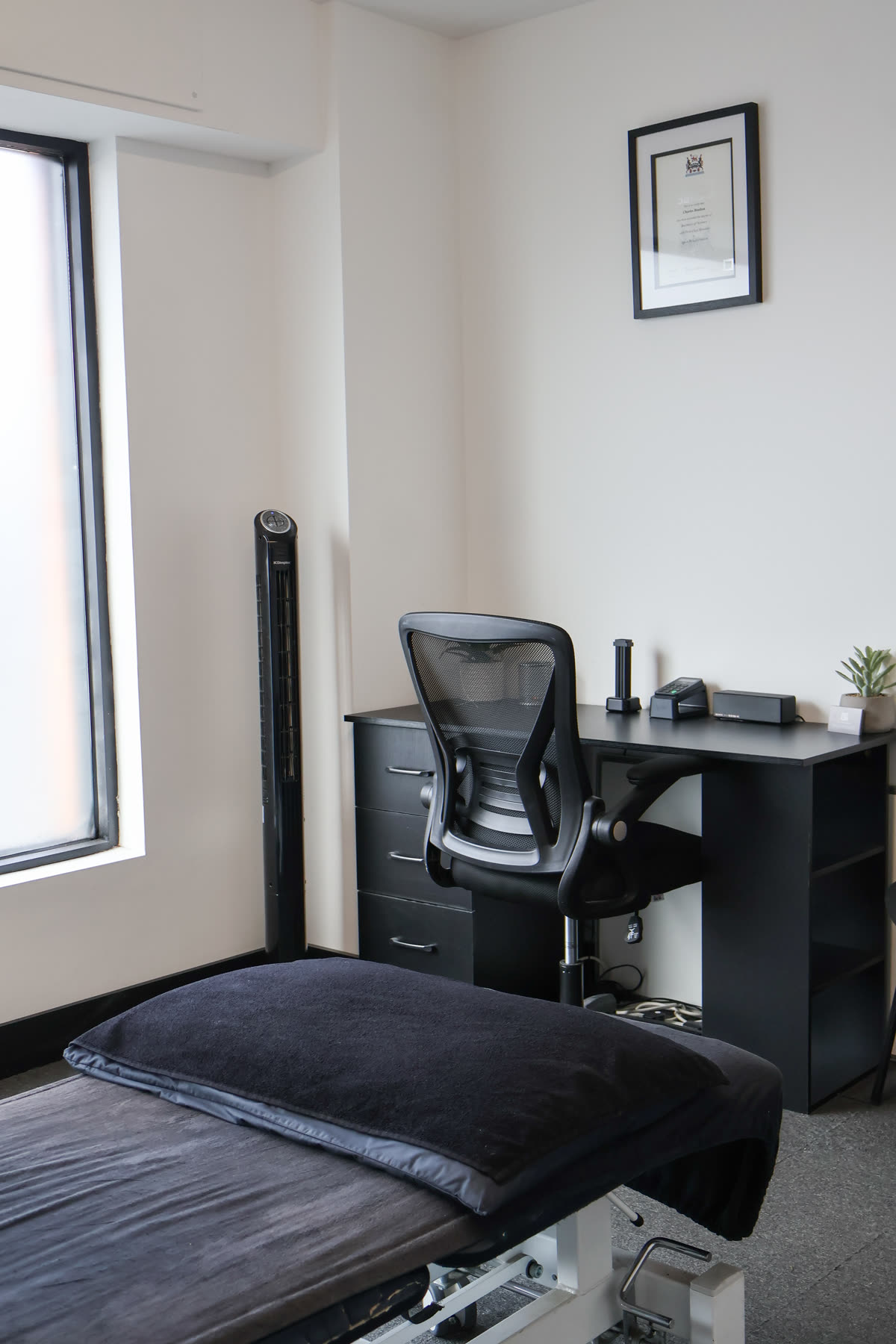
Assessment first
The treatment room at RE:UP Altrincham, 20 Huxley Street, Broadheath. A strained hamstring is assessed before anything is done to it — grade, irritability and what you are returning to all change where the programme starts.
What the hamstring evidence is actually about
Almost all of the good research on hamstring strain injury concerns rehabilitation programmes, not passive treatments. A 2014 randomised controlled trial in the British Journal of Sports Medicine followed Swedish elite sprinters and jumpers and compared two protocols; the content of the programme changed how quickly athletes returned, with lengthening-type loading outperforming conventional exercise. A 2013 randomised clinical trial in the Journal of Orthopaedic & Sports Physical Therapy compared two programmes after acute hamstring strain and looked at both clinical and structural change. A 2025 systematic review and meta-analysis has since pooled the comparative picture.
The practical read: what you do with the leg over the following weeks is the intervention. What is done to the leg on a treatment couch is an adjunct to it.
There is no comparable body of evidence showing that sports massage shortens recovery from a hamstring strain, and this page is not going to imply there is.
The reason hamstrings keep going
Pain settles before capacity comes back. A 2016 systematic review and meta-analysis in the British Journal of Sports Medicine found that strength deficits can persist after a hamstring strain injury even once symptoms have resolved. That gap — a leg that feels ready and is not — is the mechanism behind most recurrences.
It follows that “it stopped hurting” is the wrong test for going back to sprinting, and that a massage which makes the leg feel looser can actively mislead you if it is mistaken for progress. Feeling better is not the same as being able to tolerate speed, and only one of those two things protects the hamstring.
The sequence that avoids it: settle the symptoms, rebuild strength through range, add speed progressively, then return to full sprinting. The last stage is the one most often cut short, and it is the one that matters most if your sport involves running fast.
RE:UP's injury assessment is £60, follow-ups from £40, with Level 5 qualified sports therapists.
See injury rehabWhen a hamstring needs a medical opinion, not a massage
Most hamstring strains are managed with assessment and progressive loading. These presentations are different and should be seen promptly:
- —You heard or felt a pop and cannot walk on the leg.
- —Extensive bruising spreading down the back of the thigh.
- —A visible gap, lump or deformity in the muscle.
- —Severe pain high up at the sitting bone — proximal injuries are managed differently.
- —Numbness, pins and needles, or weakness in the foot.
RE:UP Altrincham is not a physiotherapy clinic and does not provide medical diagnosis. It offers sports massage and a separate sports injury assessment and rehabilitation service delivered by sports therapists, who will advise on referral where a leg needs a broader clinical scope.
Hamstring strain questions — answered
Not in the first few days, and not over the injured tissue. In the acute phase after a hamstring strain the muscle is actively repairing and direct pressure on the damaged area can disrupt that, so soft tissue work is normally kept away from the injury site until the early healing phase has passed — commonly around a week, though it depends on the grade of the strain and how it is presenting. Massage of the surrounding and compensating musculature can often start sooner. The honest answer is that the timing is a clinical judgement made on assessment, not a fixed number of days, and anyone offering a precise figure without seeing the leg is guessing.
There is no good evidence that it does. What the hamstring literature consistently shows is that the rehabilitation programme determines the outcome: a 2014 randomised controlled trial in the British Journal of Sports Medicine comparing two protocols in Swedish elite sprinters and jumpers found that the type of loading changed return-to-sport time, and a 2013 randomised clinical trial in the Journal of Orthopaedic & Sports Physical Therapy reached a similar conclusion comparing programmes. Massage may make the leg feel better and help you tolerate that programme. It is not the thing doing the repairing.
Because pain settles before capacity returns. A 2016 systematic review and meta-analysis in the British Journal of Sports Medicine found strength deficits can persist after hamstring strain injury even once symptoms have resolved — which is precisely the gap that produces reinjury when somebody returns to sprinting on the basis of feeling fine. Using "it stopped hurting" as the return test is the single most common way a hamstring strain becomes a recurring hamstring problem.
Progressive loading, built up over weeks, with an emphasis on the muscle working as it lengthens — the demand that sprinting places on it. That is what the comparative trials have tested and what distinguishes the protocols that returned athletes faster. The programme should be prescribed and progressed on reassessment rather than followed from a generic sheet, because the starting point depends on the grade of the strain and on what you are returning to.
Generally yes, and on the rest of the body. The caution is specific to the healing tissue, not to massage in general. People recovering from a hamstring strain frequently develop tightness and overload elsewhere from altering how they move, and soft tissue work on those areas is usually well tolerated and can be genuinely useful. A therapist should still know about the injury before the session so they can work around it.
Same principle as massage: keep heavy direct pressure off the injured area in the early phase. Foam rolling is just self-applied soft tissue pressure, and the fact that you are doing it yourself does not make it gentler — it is often less controlled than a therapist’s hands. Rolling the calf, glutes and quadriceps is usually fine. If rolling the hamstring reproduces the injury pain, that is the signal to leave it.
When the hamstring has the strength and the tolerance for it, which is assessed rather than counted in days. The sequence most programmes follow is: settle symptoms, rebuild strength through range, add speed progressively, then return to full sprinting. Skipping straight to running because the leg feels normal is the reinjury pattern. If you are returning to a sport with sprinting in it, the last stage matters most and is the one most often cut short.
Ice is reasonable for comfort in the first day or two, but it is not a treatment that changes the outcome of a muscle strain, and it should not be the plan. The evidence for cryotherapy in acute soft tissue injury is weak and has been questioned for years. If you want the detail on what cold and heat actually do after a hamstring strain, RE:UP has a separate guide on exactly that question.
A sports injury assessment and rehabilitation service delivered by Level 5 qualified sports therapists — initial assessment £60, follow-up sessions from £40. That is the appropriate route for a strained hamstring. Sports massage from £30 is available for the surrounding musculature and, once the injury has settled, for the hamstring itself as part of a plan. RE:UP also publishes a structured hamstring rehabilitation programme if you want to see what the loading progression looks like.
If you heard or felt a pop and cannot walk, if there is extensive bruising spreading down the leg, if there is a visible gap or lump in the muscle, if the pain is high up at the sitting bone and severe, or if you have numbness or pins and needles. Those presentations need a medical opinion rather than recovery work. A high proximal hamstring injury in particular is managed differently and should not be treated as an ordinary strain.
Sources
What this page is based on
Every clinical claim on this page is drawn from the peer-reviewed records below, each listed with the PubMed ID so it can be checked. Where the evidence is uncertain, this page says so rather than rounding it up. Guidance here is general information, not a personal diagnosis — if pain is severe, worsening, or follows a specific injury, see a clinician.
1. Br J Sports Med · 2014 · Randomised controlled trial
Acute hamstring injuries in Swedish elite sprinters and jumpers: a prospective randomised controlled clinical trial comparing two rehabilitation protocols.
Used here for: the finding that the content of the rehabilitation programme changes how quickly an athlete returns, and that lengthening-type loading outperformed conventional exercise.
PubMed 246200412. J Orthop Sports Phys Ther · 2013 · Randomised clinical trial
Clinical and morphological changes following 2 rehabilitation programs for acute hamstring strain injuries: a randomized clinical trial.
Used here for: trial-level comparison of rehabilitation programmes after an acute hamstring strain.
PubMed 234857303. Br J Sports Med · 2016 · Systematic review and meta-analysis
Hamstring strength and flexibility after hamstring strain injury: a systematic review and meta-analysis.
Used here for: the evidence that strength deficits can persist after a hamstring strain feels better, which is the basis for not using symptom relief as the return-to-running test.
PubMed 270759624. J Bodyw Mov Ther · 2025 · Systematic review and meta-analysis
Comparative effectiveness of rehabilitation protocols for hamstring injuries: A systematic review and meta-analysis.
Used here for: the current comparative picture of hamstring rehabilitation protocols.
PubMed 409546685. JBJS Rev · 2023 · Systematic review
Hamstring Injury Treatments and Management in Athletes: A Systematic Review of the Current Literature.
Used here for: the overall management picture for hamstring injury in athletes.
PubMed 37983561
Clinical content last checked against these sources on 2 November 2026.
Hamstring strain
Get it assessed, then load it properly
RE:UP Altrincham runs sports injury assessment and rehabilitation with Level 5 qualified sports therapists — £60 initial assessment, follow-ups from £40. Sports massage from £30 for the surrounding musculature, and for the hamstring itself once it has settled.
One session is £30. If you are coming more than once a month, a membership costs less per visit:
Essential
£50 /month
Four recovery sessions a month
£12.50 a visit
Unlimited
£65 /month
Unlimited sessions, up to two a day
About £7.50 a visit at twice a week
Unlimited Plus
£100 /month
Unlimited sessions plus a sports massage each month
Includes a £30 massage every month
20 Huxley Street, Broadheath, Altrincham, WA14 5EL · Open 7 days, 8am–9pm