
Recovery Guide · RE:UP Altrincham
Does an Ice Bath Help Shin Splints?
There is a weak signal — but for ice massage, not ice baths. The 2013 systematic review on shin splints listed ice massage among interventions that could be effective against control, at Level 3–4 evidence. That means ice applied directly to the shin. No study in it tested whole-body cold water immersion.
RE:UP runs two cold plunges at 4–7°C in a 90-minute Recovery Session from £20. For the shin itself, see injury rehab.
The short answer
This is the one condition in this series where cold has any supportive evidence at all — and it still does not support an ice bath.
Local ice massage and whole-body cold water immersion are different interventions. Treating evidence for one as evidence for the other is the most common way health claims get inflated, and it would be particularly easy to do here, by a business that owns two cold plunges.
What the shin splints review found about cold
A 2013 systematic review in Sports Medicine examined eleven trials of treatments for medial tibial stress syndrome. Its overall conclusion was that none of the studies were sufficiently free from methodological bias to recommend any of the treatments investigated — a genuinely poor evidence base by any standard.
Within that, it identified a group of interventions that could be effective compared with control at Level 3 to 4 evidence: iontophoresis, phonophoresis, ice massage, ultrasound therapy, periosteal pecking and extracorporeal shockwave therapy. Shockwave therapy appeared to have the most promise overall.
Ice massage is in that list. An ice bath is not, because no trial in the review tested one. The evidence concerns ice applied and moved directly over the shin — targeted, brief, local.
The two differ in dose, duration, how deeply they cool the tissue, and in everything else a whole-body cold exposure does to the body. A ten-minute immersion at 4–7°C in which the shin happens to be submerged is not a longer version of an ice massage. It is a different thing, and nobody has tested it for this condition.
What the plunges are for
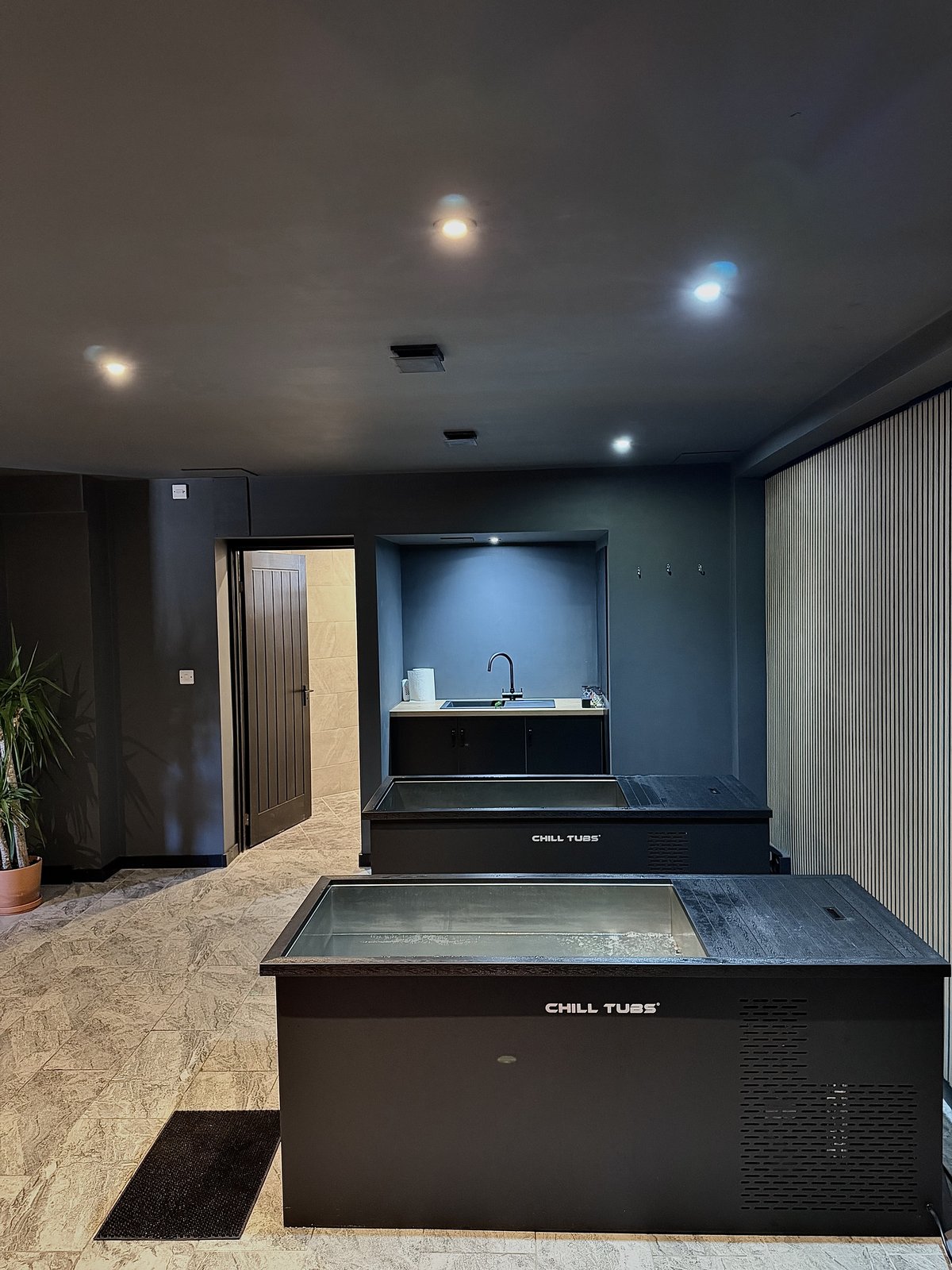
Cold plunges at RE:UP Altrincham, maintained at 4–7°C. Established for post-exercise soreness and training-load management — not tested as a treatment for medial tibial stress syndrome.
What cold water immersion is established to do
Cold has a real evidence base, and it is about recovery from exercise rather than about treating injuries. A 2021 meta-analysis in Physical Therapy in Sport pooled 32 randomised controlled trials covering 1,098 participants and found cold applied within an hour of exercise reduced delayed onset muscle soreness within the first 24 hours, with no clear effect after that.
Delayed onset muscle soreness is the ache in a muscle that has been worked hard. Shin splints is a bone stress condition, in which the tibia is being loaded faster than it can adapt. Those are different problems in different tissues, and evidence about the first says nothing about the second.
On ice for injury more broadly, a 2008 review in the Emergency Medicine Journal searched the literature on cryotherapy in acute soft tissue injury and concluded there was insufficient evidence that it improves clinical outcome. It also reported animal studies in which modest cooling reduced swelling while excessive or prolonged cooling was damaging — which is the practical argument for keeping any cold application short.
Shin pain is worth assessing before it is iced. RE:UP's injury assessment is £60, follow-ups from £40.
See injury rehabThe risk that matters: masking a stress fracture
Shin splints and a tibial stress fracture sit on the same continuum, and one of the main ways to tell them apart is how the pain behaves. Shin splints is typically diffuse along a length of the inner shin and eases as you warm up. A stress fracture tends to be sharply focal — one finger finds it — and worsens through activity rather than settling.
Cold removes exactly that information. Numbing a shin and then running on it is the sequence by which a manageable irritation becomes a fracture and a few weeks becomes a few months. If cold is what makes running possible, the signal to take from that is about your training load, not about finding better pain relief.
Used after a run rather than before, cold is far more defensible: the loading decision has already been made and all it affects is comfort.
When shin pain needs a clinician
- —Sharply focal pain on the bone you can cover with one fingertip.
- —Pain that worsens as you run rather than easing once warm.
- —Pain at rest, or that wakes you at night.
- —Swelling or a palpable lump over the bone.
- —Onset after a sharp jump in training, especially with a history of stress fracture or low energy availability.
RE:UP Altrincham is not a physiotherapy clinic, does not provide imaging and does not offer medical diagnosis. It provides recovery sessions, sports massage and a separate sports injury assessment and rehabilitation service delivered by sports therapists, who will advise on referral where a bone stress injury is suspected.
Ice baths and shin splints — answered
There is a thread of weak evidence here, which is more than can be said for most interventions in this condition — but it is not about ice baths. The 2013 systematic review of treatments for medial tibial stress syndrome listed ice massage among the interventions that could be effective compared with control, at Level 3 to 4 evidence. Ice massage means ice applied and moved directly over the shin. A whole-body cold water immersion is a different intervention, and no study in that review tested one. So the honest answer is that cold applied locally to the shin has a weak signal behind it, and the ice bath is an extrapolation from it.
Because substituting one for the other is exactly the move that makes health content unreliable. Ice massage is targeted, brief and applied directly to the painful area of bone and overlying tissue. Cold water immersion is a whole-body exposure at 4–7°C in which the shin happens to be included. They differ in dose, duration, depth of cooling and in what else they do to the body. A page that quotes ice-massage evidence to recommend an ice bath has made an unearned leap, and this page is not going to make it.
Locally and briefly, if it helps you feel better, is reasonable — and it has marginally more support in this condition than it does in most. The caution is dose. A 2008 review in the Emergency Medicine Journal reported animal studies in which modest cooling reduced swelling while excessive or prolonged cooling was damaging, and the same review concluded there was insufficient evidence overall that cryotherapy improves clinical outcome in soft tissue injury. Short applications, not long ones.
Reduce post-exercise muscle soreness, mainly. A 2021 meta-analysis of 32 randomised controlled trials covering 1,098 participants found cold applied within an hour of exercise reduced delayed onset muscle soreness within 24 hours, with no clear effect beyond. That is a finding about sore muscles after hard training. Shin splints is a bone stress condition in which the tibia is being loaded faster than it is adapting. The two are not the same problem, and evidence about one establishes nothing about the other.
It can mask the pain that would otherwise tell you something is wrong, and in this condition that is a genuine risk rather than a theoretical one. Shin splints and a tibial stress fracture sit on the same continuum, and pain behaviour is one of the main ways to tell them apart — a stress fracture tends to be focal and to worsen with running rather than easing. Numbing the shin and running on it removes the signal at the point you most need it.
After, if at all. Using cold before a run numbs a shin you are about to load, which is the sequence most likely to let you run through a bone problem. Afterwards the training decision is already made and cold is only affecting comfort. If your shin needs numbing in order to run, that is information about your training load rather than a reason to find a better analgesic.
Managing the training load that is irritating the tibia, and establishing whether a bone stress injury is present. The evidence base for treatments in this condition is genuinely poor — the 2013 review concluded that none of the studies examined were sufficiently free from methodological bias to recommend any treatment at all. That absence shifts the useful work towards assessment and scheduling rather than towards any therapy, cold included.
Yes — a recovery session manages training load and comfort, and shin splints is not a reason to avoid one. What it should not be is your plan for the shin. RE:UP Altrincham has two cold plunge ice baths at 4–7°C and an 8-person Finnish sauna, in a 90-minute Recovery Session from £20. For the shin itself, the sports injury assessment with Level 5 qualified therapists is £60.
No. RE:UP is not a physiotherapy clinic and does not provide imaging or medical diagnosis. It offers recovery sessions, sports massage and a separate sports injury assessment and rehabilitation service delivered by sports therapists. Where shin pain suggests a bone stress injury that needs a scan, RE:UP’s therapists will advise on the referral pathway rather than treating it.
If the pain is sharply focal and you can point to it with one finger, if it worsens through a run rather than easing, if it hurts at rest or at night, if there is swelling over the bone, or if it followed a sharp jump in training. Those features point towards bone stress injury. An ice bath will make that shin feel better and will not make it any safer to run on.
Sources
What this page is based on
Every clinical claim on this page is drawn from the peer-reviewed records below, each listed with the PubMed ID so it can be checked. Where the evidence is uncertain, this page says so rather than rounding it up. Guidance here is general information, not a personal diagnosis — if pain is severe, worsening, or follows a specific injury, see a clinician.
1. Sports Med · 2013 · Systematic review
Treatment of medial tibial stress syndrome: a systematic review.
Used here for: the finding that ice massage was among the interventions that could be effective against control at Level 3–4 evidence, and the overriding conclusion that no treatment examined was free enough of bias to be recommended.
PubMed 239799682. Phys Ther Sport · 2021 · Meta-analysis of 32 randomised controlled trials
Heat and cold therapy reduce pain in patients with delayed onset muscle soreness: A systematic review and meta-analysis of 32 randomized controlled trials.
Used here for: what cold water immersion is actually established to do — reduce post-exercise muscle soreness within 24 hours — as distinct from treating a bone stress condition.
PubMed 334939913. Emerg Med J · 2008 · Review
Is ice right? Does cryotherapy improve outcome for acute soft tissue injury?
Used here for: the conclusion that evidence for cryotherapy improving clinical outcome is insufficient, and the animal finding that excessive or prolonged cooling is damaging.
PubMed 182121344. J Athl Train · 2016 · Evidence-based review
Risk Factors for Medial Tibial Stress Syndrome in Active Individuals: An Evidence-Based Review.
Used here for: what is established about who develops medial tibial stress syndrome.
PubMed 27835043
Clinical content last checked against these sources on 2 November 2026.
Shin splints
Use the plunge for what it is tested on
Two cold plunges at 4–7°C and an 8-person Finnish sauna in a 90-minute Recovery Session from £20 — for soreness and training-load management. For a shin that keeps hurting, RE:UP's injury assessment with Level 5 qualified therapists is £60.
One session is £20. If you are coming more than once a month, a membership costs less per visit:
Essential
£50 /month
Four recovery sessions a month
£12.50 a visit
Unlimited
£65 /month
Unlimited sessions, up to two a day
About £7.50 a visit at twice a week
Unlimited Plus
£100 /month
Unlimited sessions plus a sports massage each month
Includes a £30 massage every month
20 Huxley Street, Broadheath, Altrincham, WA14 5EL · Open 7 days, 8am–9pm