
Recovery Guide · RE:UP Altrincham
Does an Ice Bath Help Runner’s Knee?
There is no evidence that it treats it. Runner’s knee is patellofemoral pain, and cold water immersion appears nowhere in the 2018 international consensus on treating it — not as recommended, not as uncertain, not as discouraged. Cold can numb an irritable knee. That is a different claim.
RE:UP runs two cold plunges at 4–7°C in a 90-minute Recovery Session from £20. For a knee that keeps flaring, see injury rehab.
The short answer
This is a business that sells ice baths saying that ice baths are not a treatment for runner’s knee. They are good for other things, and that is the subject of other pages. For patellofemoral pain specifically, the evidence is not there.
The more interesting detail is not that cold was tested and failed. It is that it was never part of the conversation: when 41 international experts sorted the available interventions for patellofemoral pain into recommended, uncertain and not recommended, cold water immersion was in none of the three lists.
What the consensus actually covered
The 2018 consensus statement from the International Patellofemoral Research Retreat, published in the British Journal of Sports Medicine, reviewed the systematic reviews and randomised trials available and put the results to a panel of 41 patellofemoral pain experts for discussion and voting.
It recommended exercise therapy — particularly hip-focused combined with knee-focused work — along with combined interventions and foot orthoses. It placed manual soft tissue techniques, taping, bracing, dry needling, blood flow restriction and gait retraining in an uncertainty category. It recommended against knee or lumbar mobilisations used in isolation, and against electrophysical agents.
Cold water immersion is absent from all three categories. The honest summary is not “ice baths do not work for runner’s knee” but “ice baths have not been established as a treatment for runner’s knee” — which, for someone deciding how to spend their time and money, amounts to the same practical advice.
What the plunges are for
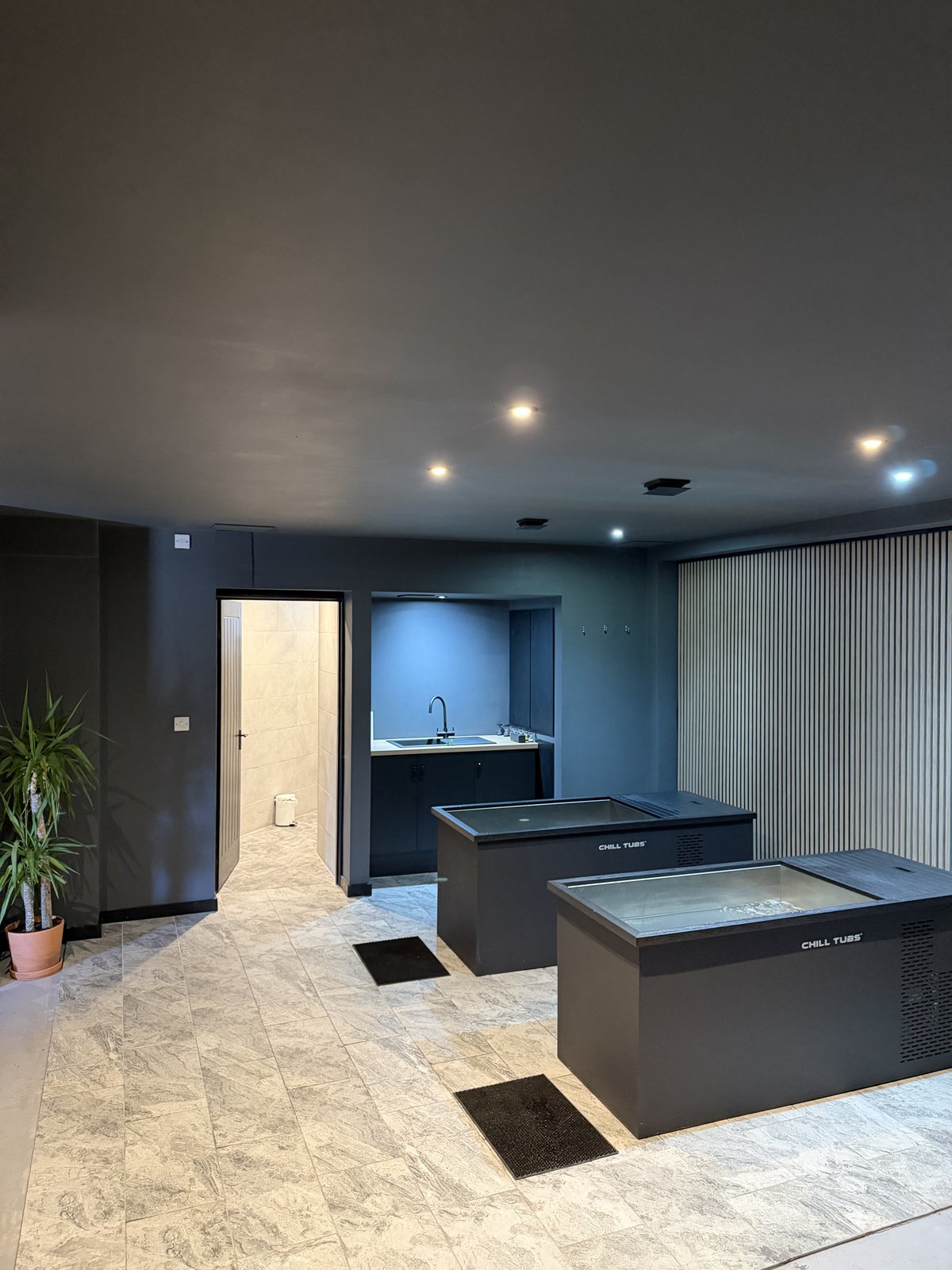
One of two cold plunge ice baths at RE:UP Altrincham, maintained at 4–7°C. They are used for managing training load and post-exercise soreness — the things cold water immersion has actually been studied for — rather than as a treatment for a painful knee.
What cold water immersion is proven to do
Cold has a real evidence base — it is simply about a different question. The research has overwhelmingly asked how cold water immersion affects recovery after hard exercise, not how it affects a joint condition.
A 2021 meta-analysis in Physical Therapy in Sport pooled 32 randomised controlled trials covering 1,098 participants and found that cold therapy applied within an hour of exercise reduced the pain of delayed onset muscle soreness within the first 24 hours, with no clear effect after that. A 2023 systematic review with meta-regression in Sports Medicine compared cold water immersion against other recovery methods for restoring athletic performance after acute strenuous exercise. A 2025 systematic review in PLoS One examined effects on health and wellbeing more broadly.
Soreness after a hard session is a different thing from patellofemoral pain. Evidence about the first does not transfer to the second, and a page that quotes DOMS research to sell you an ice bath for your knee is making a substitution it has not earned.
A knee that keeps flaring is worth assessing. RE:UP's injury assessment is £60, follow-ups from £40.
See injury rehabThe actual risk, which is not the cold
Cold water immersion is not going to damage your knee. The risk is what the pain relief lets you do. Pain is the main information you have about how irritable the joint currently is, and patellofemoral pain is a condition managed largely by adjusting load. Remove the signal and the adjustment does not happen.
This is most relevant immediately before running. Numbing a knee and then loading it is precisely the sequence that turns a manageable irritation into a longer problem. After a run, cold is more defensible — the training decision has already been made.
There is also a reason not to ice reflexively after every session: routine post-exercise cold has been shown in resistance training contexts to interfere with some of the adaptations training is meant to produce. If the plan for your knee is to build its tolerance, blunting adaptation after every session is working against the plan.
Ice baths and knee pain — answered
There is no evidence that it treats it. Runner’s knee is patellofemoral pain, and the 2018 international consensus statement on patellofemoral pain — the product of 41 experts reviewing the literature — does not include cold water immersion anywhere in its recommendations. It is not listed as recommended, not as uncertain, and not as discouraged. It simply has not been established as a treatment for this condition. An ice bath may numb an irritable knee for a while, which some people find useful, but numbing a symptom and treating the problem are different things.
Because cold genuinely reduces pain in the short term, and a knee that hurts less feels better. That effect is real and it is also temporary. The risk is mistaking it for progress: if the ice bath lets you keep running at the volume that is irritating the knee, it has helped you maintain the thing that is causing the problem. Short-term symptom relief is useful when it buys you the ability to do your rehabilitation. It is a poor substitute for it.
They have been studied mainly for recovery after strenuous exercise, not for treating injuries or joint conditions. A 2021 meta-analysis of 32 randomised controlled trials found that cold applied within an hour of exercise reduced delayed onset muscle soreness for up to 24 hours, with no clear effect beyond that. A 2023 systematic review and meta-regression in Sports Medicine examined cold water immersion against other recovery methods for restoring athletic performance after hard sessions. Those are the questions the research has asked. Patellofemoral pain is not among them.
Loading. The 2018 consensus recommends exercise therapy, specifically the combination of hip-focused and knee-focused exercise, and a 2018 systematic review with meta-analysis in the Journal of Orthopaedic & Sports Physical Therapy found that strengthening the hip as well as the knee reduced pain and improved activity more than knee strengthening alone. A structured programme built over weeks is the intervention. Cold is not an alternative to it.
Not directly, in the sense that cold water immersion is not going to damage the joint. The indirect risk is the one that matters: numbed pain can let you train through a knee that needed its load reduced, and pain is the main signal you have about how irritable the joint currently is. Using cold immediately before running, in particular, removes that signal at exactly the moment you need it.
For post-exercise soreness, the 2021 meta-analysis found both reduced pain with no statistically significant difference between them — cold worked within the first 24 hours, heat worked both within and beyond. For patellofemoral pain specifically, neither has been established as a treatment. In practice most people find cold more comfortable on an irritable, swollen-feeling knee and heat more comfortable on a stiff one, and choosing on comfort is reasonable given the evidence does not favour either.
There is no good reason to, and a small reason not to. Routinely applying cold after training has been shown in other contexts to interfere with some of the adaptations that training is meant to produce. If your knee is sore after a run, the more useful questions are whether the run was too long, too fast or too hilly for where the knee currently is, and what you are doing to build its tolerance.
Usually, yes — a recovery session is about managing training load and comfort, and plenty of people with a grumbly knee use one. But it should not be the plan for a knee that keeps flaring. RE:UP Altrincham runs a separate sports injury assessment and rehabilitation service with Level 5 qualified sports therapists, initial assessment £60, and for recurring patellofemoral pain that is the appropriate route. Recovery sessions are from £20.
RE:UP Altrincham has two cold plunge ice baths maintained at 4–7°C, alongside an 8-person Finnish sauna at 90–110°C. A 90-minute Recovery Session from £20 gives access to the full facility, including Normatec compression and a mobility zone, at 20 Huxley Street, Broadheath.
If the knee locked, gave way, or swelled rapidly after a specific incident; if you cannot bear weight; if there is marked swelling, redness or heat; if pain wakes you at night; or if it is steadily worsening despite reducing your running. Those presentations need a clinician. An ice bath is not a diagnostic tool and will mask exactly the signals that matter.
Sources
What this page is based on
Every clinical claim on this page is drawn from the peer-reviewed records below, each listed with the PubMed ID so it can be checked. Where the evidence is uncertain, this page says so rather than rounding it up. Guidance here is general information, not a personal diagnosis — if pain is severe, worsening, or follows a specific injury, see a clinician.
1. Br J Sports Med · 2018 · International consensus statement
2018 Consensus statement on exercise therapy and physical interventions (orthoses, taping and manual therapy) to treat patellofemoral pain: recommendations from the 5th International Patellofemoral Pain Research Retreat, Gold Coast, Australia, 2017.
Used here for: the recommendation of hip-and-knee exercise therapy, and the fact that cold water immersion appears nowhere in the statement — not as recommended, not as uncertain, not as discouraged.
PubMed 299255022. J Orthop Sports Phys Ther · 2018 · Systematic review with meta-analysis
Hip and Knee Strengthening Is More Effective Than Knee Strengthening Alone for Reducing Pain and Improving Activity in Individuals With Patellofemoral Pain: A Systematic Review With Meta-analysis.
Used here for: what the evidence does support for patellofemoral pain, as a contrast to cold.
PubMed 290348003. Phys Ther Sport · 2021 · Meta-analysis of 32 randomised controlled trials
Heat and cold therapy reduce pain in patients with delayed onset muscle soreness: A systematic review and meta-analysis of 32 randomized controlled trials.
Used here for: that cold applied within an hour of exercise reduces delayed onset muscle soreness for up to 24 hours — a finding about post-exercise soreness, not about treating a knee condition.
PubMed 334939914. Sports Med · 2023 · Systematic review, meta-analysis and meta-regression
Effects of Cold-Water Immersion Compared with Other Recovery Modalities on Athletic Performance Following Acute Strenuous Exercise in Physically Active Participants: A Systematic Review, Meta-Analysis, and Meta-Regression.
Used here for: what cold water immersion has actually been tested for — recovery of performance after strenuous exercise.
PubMed 365275935. PLoS One · 2025 · Systematic review and meta-analysis
Effects of cold-water immersion on health and wellbeing: A systematic review and meta-analysis.
Used here for: the broader picture of what cold water immersion has been studied for.
PubMed 39879231
Clinical content last checked against these sources on 2 November 2026.
Runner's knee
Use the plunge for what it is good at
Two cold plunges at 4–7°C and an 8-person Finnish sauna, in a 90-minute Recovery Session from £20 — for managing training load and soreness. For a knee that keeps flaring, RE:UP's injury assessment with Level 5 sports therapists is £60, follow-ups from £40.
One session is £20. If you are coming more than once a month, a membership costs less per visit:
Essential
£50 /month
Four recovery sessions a month
£12.50 a visit
Unlimited
£65 /month
Unlimited sessions, up to two a day
About £7.50 a visit at twice a week
Unlimited Plus
£100 /month
Unlimited sessions plus a sports massage each month
Includes a £30 massage every month
20 Huxley Street, Broadheath, Altrincham, WA14 5EL · Open 7 days, 8am–9pm